japanese knife rental indonesia · rent japanese knife · aogami · blue steel · blue paper steel · aogami super · shirogami vs aogami · japanese knife steel
Aogami Blue Steel Explained: Grades, Retention, Service Fit
29 July 2026
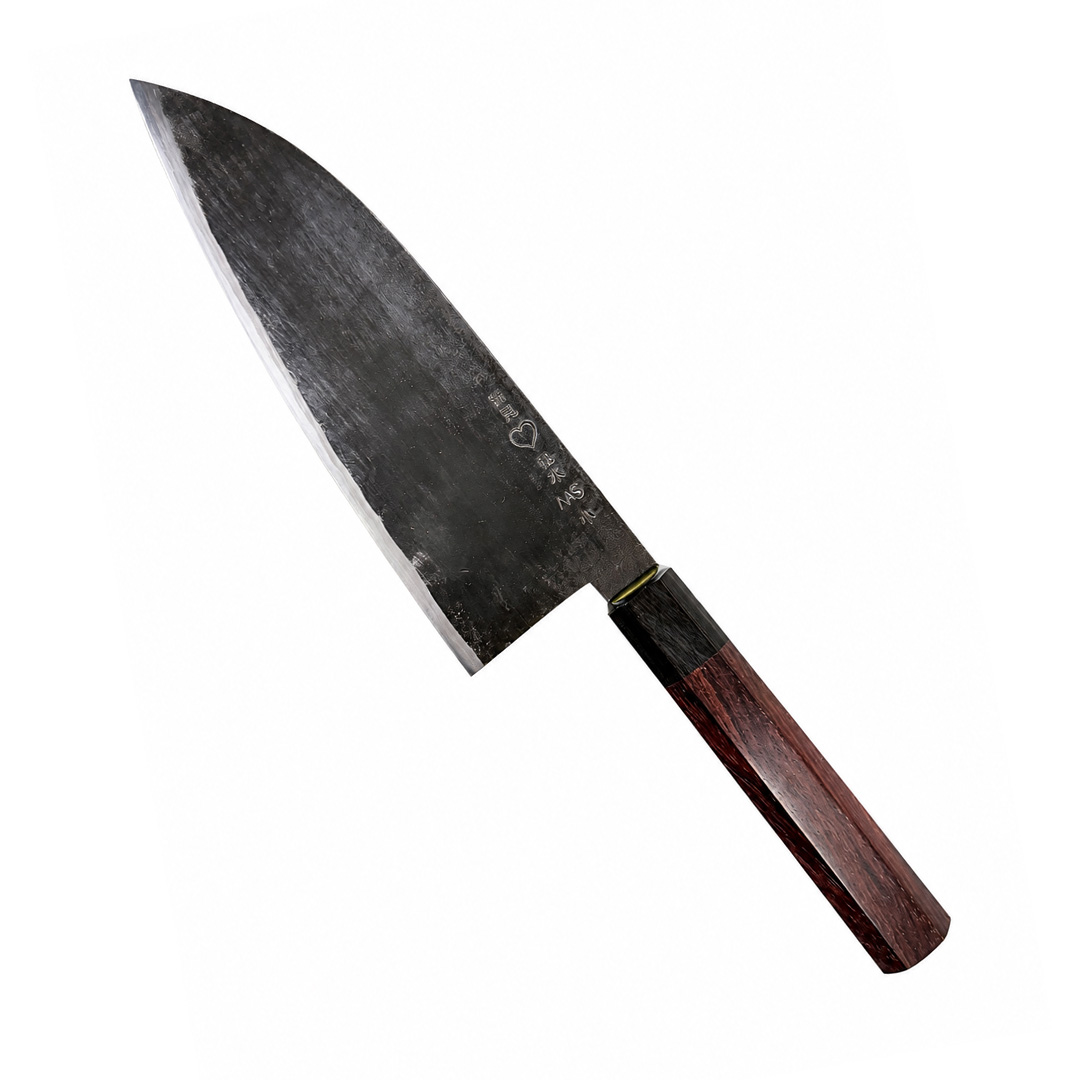
What aogami (blue paper steel) adds to white steel's formula, how the grades differ, and what that means for a chef choosing an edge.
# Aogami Blue Steel Explained: Grades, Retention, Service Fit
Aogami starts as the same formula as shirogami — the purity story we cover in our white steel article — and then adds two things: tungsten, at roughly 1.0–2.0%, and chromium, at roughly 0.2–0.5%. That small addition changes the whole personality of the steel. Where shirogami sells purity, aogami sells staying power.
The formula and the grades
Blue #1 runs about 1.2–1.4% carbon, Blue #2 about 1.0–1.2% carbon — the same carbon-tier logic as white steel's #1 and #2, just with tungsten and chromium layered on top. Then there is Aogami Super, the outlier of the family: roughly 1.40–1.50% carbon, 2.0–2.5% tungsten, plus molybdenum around 0.3–0.5% and vanadium around 0.3–0.5%. It is the hardest steel Yasugi rolls, typically 63–67 HRC. The molybdenum and vanadium refine the grain structure, which is part of why Aogami Super is often described as less prone to chipping than its hardness alone would suggest — though that specific comparison circulates mostly through retailer and community consensus rather than a lab figure, so take it as informed opinion rather than a spec sheet number.
What tungsten and chromium actually buy you
The tungsten and chromium carbides give aogami noticeably longer edge retention and somewhat better wear behavior than shirogami, at a real cost: it sharpens a bit harder, and the ultimate edge feel is a touch less pure than what shirogami can deliver in the right hands. It is still fully reactive carbon steel underneath the alloying — chromium at 0.2–0.5% is nowhere near enough to make it stainless, so it needs the same rust discipline as any carbon blade: dry it, oil it, let a patina build rather than fighting it.
Typical hardness across the family: Blue #1 and Blue #2 sit around 61–65 HRC, Aogami Super around 63–65 HRC and up.
Who reaches for which grade
Blue #2 is the grade most cooks meet first — it is common under kurouchi finishes from Tosa smiths and gives a real step up in retention over White #2 without asking for dramatically more skill at the stone. Blue #1 pushes retention and edge stability further for cooks who sharpen less often but still want a traditional carbon feel. Aogami Super is the steel serious edge-retention chasers ask for by name — Takeda Hamono is a maker closely associated with it — and it rewards a cook who already has confident stone technique, because getting the most out of that hardness takes some care.
The honest service trade-off
Here is the candid note: aogami is not simply "better shirogami." It trades some of shirogami's easy, effortless keenness for a longer working life on the board. A chef running long prep shifts and touching up only every few days will likely prefer aogami's staying power. A chef who sharpens fresh every morning and chases the absolute cleanest edge feel may still prefer shirogami. Neither is the wrong answer — it is a question of how often a cook wants to be at the stone.
In the Reserve
The Reserve currently carries a Satoshi Nakagawa × Naohito Myojin Aogami #1 santoku, finished with an amboyna handle by Byan Hoja — a piece that puts Blue #1's retention and edge stability behind a genuinely collaborative build between smith and handle maker. For the finishes that typically dress an aogami edge, our companion article on Japanese knife finishes covers kurouchi, kasumi, and the rest, and how each interacts with a reactive carbon core.
Pieces carrying aogami move through the Reserve one Patron at a time. If a service needs an edge that holds through a longer shift without extra trips to the stone, it is worth seeing what is currently available to reserve.
Hagane Reserve is a premium **Japanese knife rental** in Indonesia — aogami pieces held for one Patron at a time. See what is currently in the Reserve.