honyaki vs damascus Japanese knives · honyaki · damascus knife · san-mai · hamon
Honyaki vs Damascus: What Japanese Knives Ask of Their Steel
23 July 2026
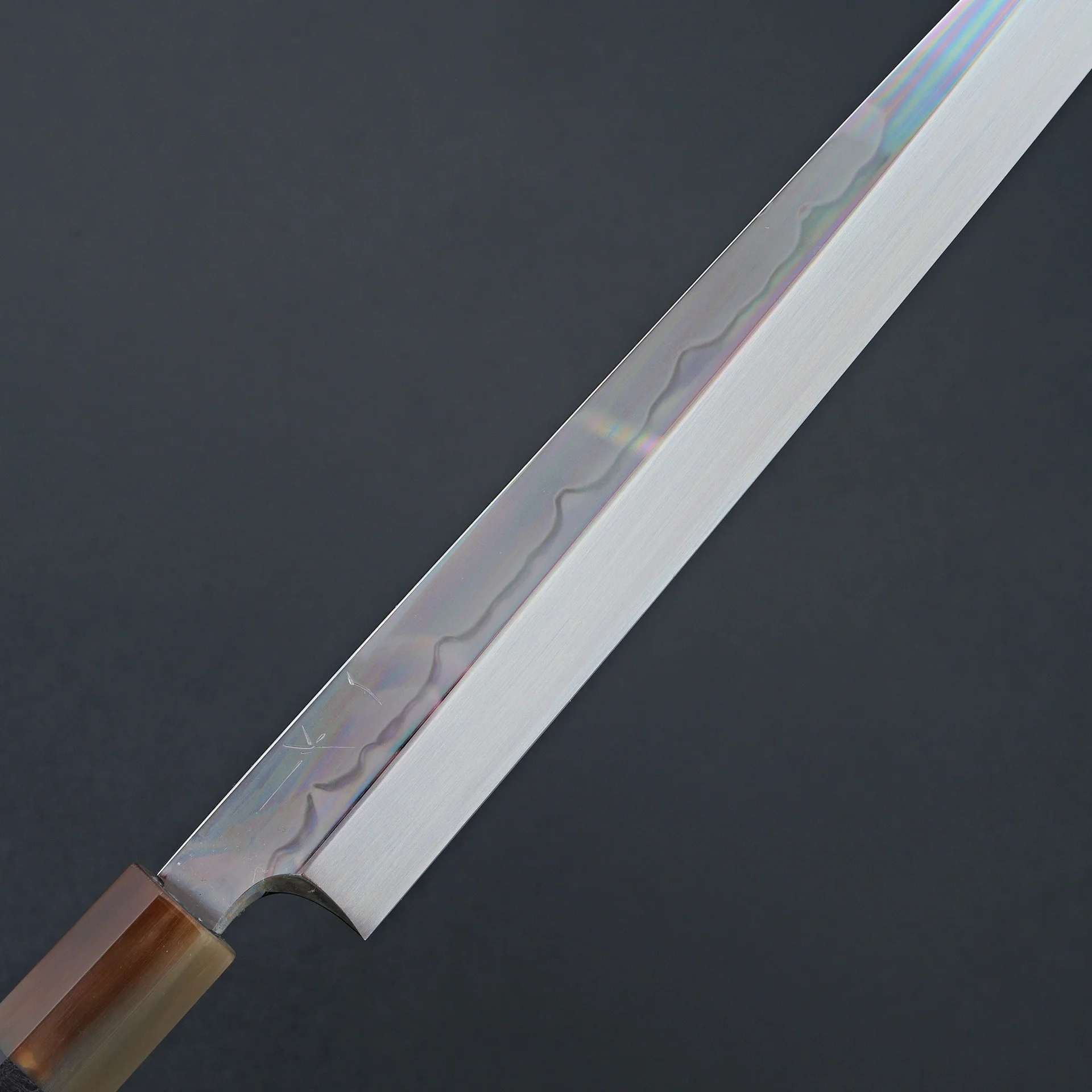
Honyaki vs damascus Japanese knives explained: mono-steel honyaki with a real hamon, damascus and suminagashi lamination, and san-mai construction.
One Steel, or Many Folded Together
Every Japanese blade construction is a decision about what the steel should carry: hardness alone, hardness supported by softer steel, or a pattern that reveals the layering itself. Honyaki, damascus, and san-mai are the three answers you will meet most often in the Reserves, and each one asks something different of the smith who makes it and the Patron who holds it.
Honyaki: One Steel, Water / Oil - Quenched (Mizu / Abura)
Honyaki means the entire blade — spine to edge — is a single piece of carbon steel, hardened the way a traditional Japanese sword is: heated, clay-coated in a differential pattern, and quenched in water rather than the gentler oil bath most kitchen knives get. Water quenching is faster and far less forgiving. It hardens the edge to an exceptional degree, but the same speed that gives honyaki its edge-holding also makes the blade brittle and prone to cracking during the quench itself — which is why very few smiths attempt it, and fewer still are trusted to do it reliably.
The reward for that risk is a real hamon: the wavy line separating the hardened edge from the softer spine, visible because it is a genuine boundary in the crystal structure of the steel, not an etched or applied pattern. A honyaki blade is unforgiving of impact — it should never hit bone or a frozen block — and it demands a drier, more attentive keeper. In exchange, it holds an edge longer than almost anything else in steel, and its hamon is unrepeatable: no two water quenches trace the line the same way.
Damascus and Suminagashi: The Pattern Is the Lamination
Damascus construction folds two or more steels together — often a hard carbon core steel between visually contrasting outer layers — then etches the surface so the folds show as a pattern. Suminagashi ("floating ink") is the same principle refined toward flowing, wood-grain-like lines rather than bold contrast. Neither pattern is decoration painted onto the blade afterward; it is the actual lamination revealed. Nothing is printed and nothing rubs off, because the metals themselves — sometimes steel and copper, sometimes two grades of steel — are what you are seeing.
The outer layers in a damascus construction are typically softer than the cutting core, which means the blade as a whole is tougher and more forgiving than a mono-steel honyaki, while the hard core still delivers a fine edge. Damascus is the construction that lets a smith be honest about complexity and expressive about pattern at the same time — every finished blade's pattern is singular, a record of exactly how that billet was folded and forged.
San-Mai: Three Layers, One Purpose
San-mai — "three layers" — is the classic construction behind that logic: a hard, high-performance core steel sandwiched between two layers of softer, tougher steel (often stainless, for a blade that resists staining at the spine and shoulders while cutting with a harder edge). It is less about visual pattern and more about combining properties that don't naturally coexist in one steel — cutting performance from the core, resilience from the cladding.
What Each One Signals
None of these constructions is "better" in the abstract — they signal different priorities. Honyaki signals a smith willing to risk the quench for the sake of the edge and the hamon; damascus and suminagashi signal a smith folding complexity into something you can see; san-mai signals an engineer's answer to combining hardness and toughness. Reading a piece's construction correctly tells you, before you ever pick it up, what kind of hand it will reward.
Held, Not Owned, for a Reserve Period
Whichever construction speaks to you — a honyaki with its unrepeatable hamon, or a damascus folded with real metal — the piece is entrusted to a Patron for a Reserve period, never sold. Explore the constructions in the collection at Hagane Reserves.
Picture credits to carbon knife co, hitohira togashi sanbonsugi (three cedars) honyaki