how to care for Japanese knives · Japanese knife care · carbon steel patina · saya storage · knife sharpening
How to Care for Japanese Knives: A Practical Guide for Carbon and Stainless Blades
23 July 2026
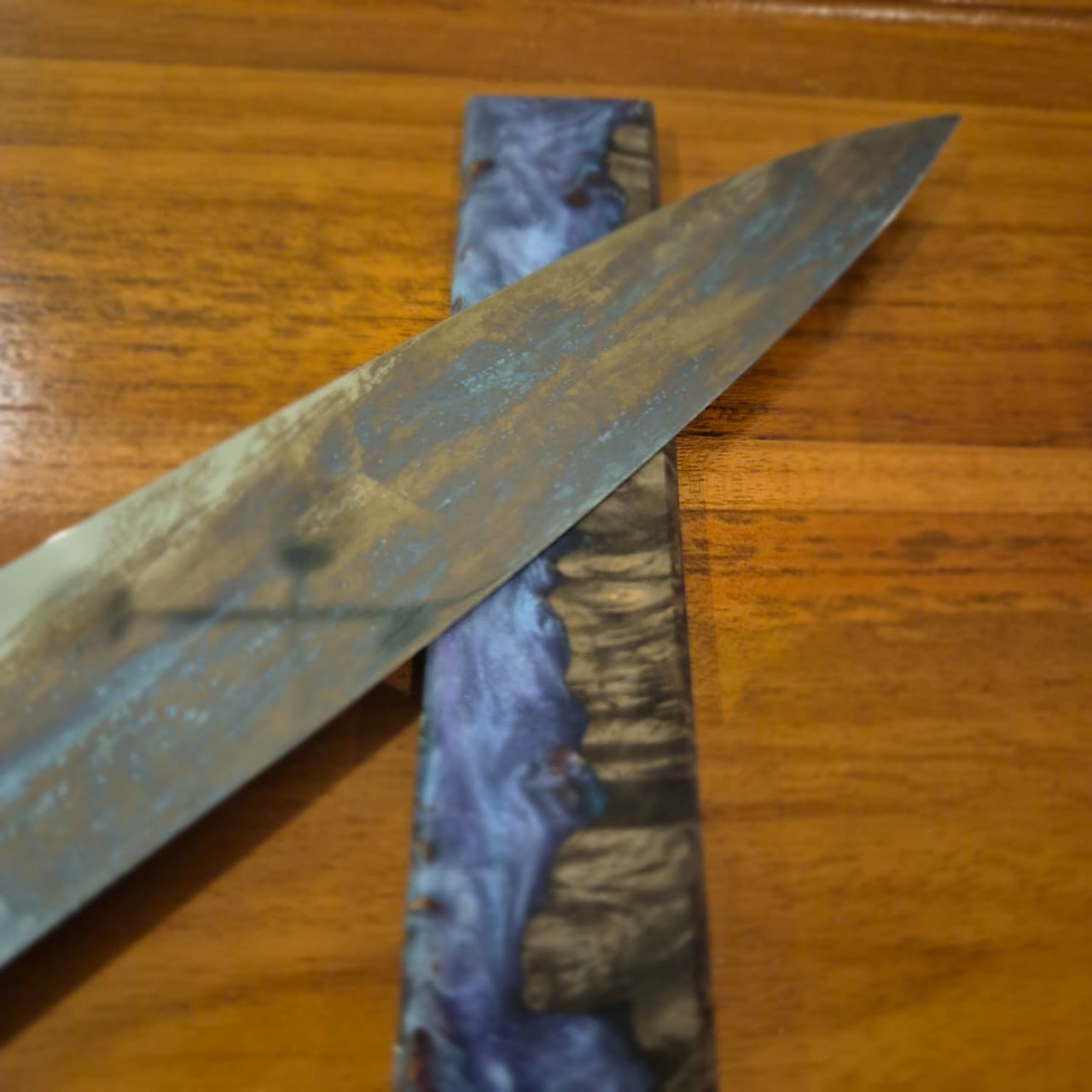
How to care for Japanese knives: patina versus rust, drying, cutting boards, saya storage, and when a piece needs professional sharpening.
Patina Is Not Rust — Learn to Tell Them Apart
If a knife has a carbon steel core, it will change color with use. That is patina: a thin, stable oxide layer that forms naturally and actually protects the steel underneath. It usually appears as gray, blue, or straw tones, sometimes uneven, sometimes in streaks that trace exactly where the blade met acidic food. Patina is not damage. It is a record of use, and most carbon-steel owners come to like the way it looks.
Rust is different: rough, orange-red, and it pits the surface rather than sealing it. The difference in cause is simple — patina forms on a blade that was used and then dried; rust forms on a blade that was left wet. The fix for early rust is the same as the habit that prevents it: wipe the blade dry immediately, then a light pass with a damp cloth and a little oil if any rust has already started.
The One Habit That Matters Most: Wipe It Dry
Whether the core is carbon or stainless, water sitting on the blade — especially with salt, acid, or food residue still on it — is the single biggest cause of damage. Wipe the blade dry with a cloth immediately after use, before it ever goes near a drying rack. For a carbon steel piece, a very thin film of camellia oil afterward is the traditional finishing touch, the same oil Japanese sword keepers have used for centuries.
Never the Dishwasher
A dishwasher's heat, moisture cycles, and the way blades knock against other utensils are close to the worst possible environment for a fine Japanese blade — for the edge, the handle material, and any lacquer or natural finish. Hand-wash only, dry immediately, and never let the blade sit in a sink of standing water even briefly.
The Right Cutting Board
A hard glass, stone, or ceramic board will dull and can even chip a fine edge in a handful of cuts — the board is harder than the steel it is meeting. Wood and quality plastic (or composite) boards are kind to an edge because they give slightly under it. End-grain wood boards are the gentlest option and are what most professional Japanese kitchens use.
Storage: Why a Saya Matters
A saya — the wooden sheath that comes with many Japanese knives — protects the edge from knocking against other tools in a drawer, and keeps the blade from air that carries ambient moisture. Store the knife dry, in its saya or on a proper knife block or magnetic strip, never loose in a drawer where the edge meets metal or ceramic on every open and close.
When to Send It for Professional Sharpening
A steel or ceramic honing rod between uses realigns the edge, but it doesn't sharpen it — that only happens on a stone. When a blade starts crushing rather than slicing a tomato skin, or catching instead of gliding through paper, it's past what honing can fix. At that point, professional sharpening — ideally by a togishi trained specifically in Japanese geometry — restores the edge properly, rather than a quick pull through a pull-through sharpener, which tends to grind away far more steel than necessary and can ruin the original bevel.
Care, Extended to a Reserve Period
Every piece in the Reserves is entrusted, not sold, and the same care above is exactly what a Reserve period asks of a Patron — wipe it dry, keep it out of the dishwasher, and use the board and saya it deserves. Discover the collection at Hagane Reserves.