double bevel japanese knife · gyuto vs santoku · bunka knife · nakiri knife · sujihiki · japanese knife rental indonesia · rent japanese knife
Japanese Double-Bevel Knives: A Chef's Guide
3 August 2026
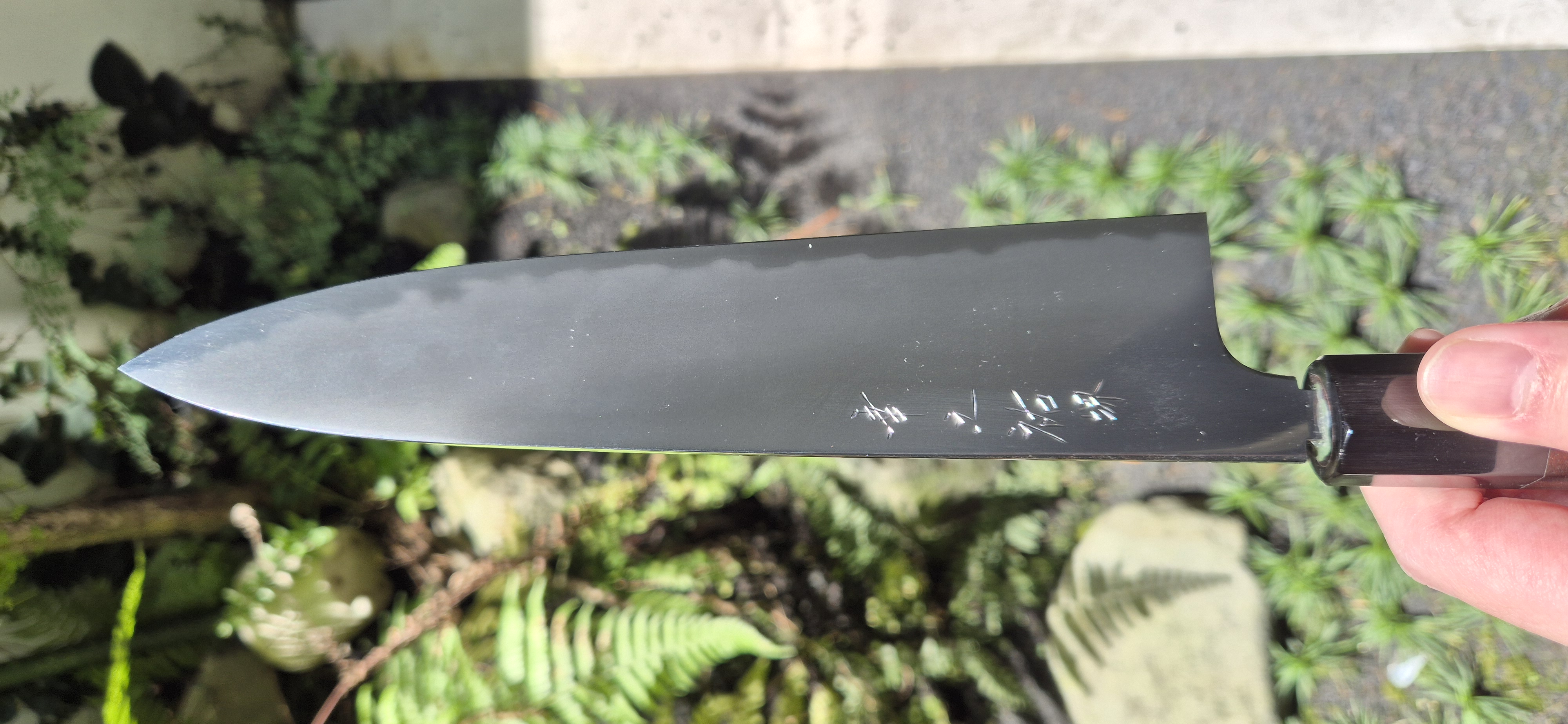
Gyuto, santoku, bunka, nakiri, sujihiki and more — how double-bevel Japanese knives divide the work on a real board, for chefs in Indonesia.
# Japanese Double-Bevel Knives: A Chef's Guide
Most of the knives a Western-trained chef reaches for every day are double-bevel — ground evenly on both faces, forgiving of hand position, comfortable to push, pull, or rock. They are the generalists of the Japanese knife world, built to survive a full shift of mixed work rather than one task done perfectly. Here is how the double-bevel family actually divides the labor on a professional board.
Gyuto — the workhorse
The gyuto, typically 210–270mm, is the closest thing Japan has to a Western chef's knife, and it is the piece most line cooks reach for first. Protein, vegetables, herbs — the gyuto covers all of it competently, which is exactly why a kitchen that owns only one Japanese knife usually owns this one. Length is a service decision, not a status one: 210mm suits a tight station, 240mm gives more blade for breaking down larger cuts, and 270mm belongs to cooks who process high volume and want the extra length to keep the edge clear of the board on long strokes.
Santoku and bunka — close cousins, different tips
The santoku (165–180mm) means "three virtues" — meat, fish, vegetables — and it earned that name as a flatter, shorter alternative to the gyuto that home cooks and prep cooks alike find easy to control. The bunka sits in the same size range and does much of the same work, but it trades the santoku's rounded tip for an angular k-tip, a reverse-tanto profile borrowed from the kiritsuke family. The classic confusion between the two comes down entirely to that tip: the bunka's pointed k-tip lets a cook score, pierce, and do fine detail work the santoku's rounded nose simply can't reach as cleanly. If your prep leans toward garnish and precision cuts, the bunka earns its keep; if it's straightforward chopping, the santoku's shorter, flatter profile is the more relaxed tool.
Nakiri — the vegetable specialist
The nakiri is a rectangular double-bevel vegetable knife, 165–180mm, built for full-length push cuts through onions, cabbage, and root vegetables without the rocking motion a curved edge demands. It is the home and prep-line counterpart to the professional usuba — same job, more forgiving geometry, no single-bevel technique required. A kitchen doing heavy vegetable prep will feel the difference the first shift it's in rotation.
Petty and sujihiki — the precision and reach specialists
The petty (120–150mm) is the pro's paring and utility knife: peeling, herbs, small board work where a full-size gyuto is overkill. The sujihiki (240–300mm) sits at the other end of the size scale — a double-bevel slicer for carving roasts and portioning proteins with long, clean draws. It is worth being precise about the sujihiki's neighbor here, because it is the most commonly confused pairing in the whole double-bevel lineup: sujihiki vs yanagiba. The sujihiki is double-bevel and built for general slicing and carving; the yanagiba is single-bevel and dedicated to sashimi work, where the flat, ground face and urasuki hollow give a cleaner release than any double-bevel edge can manage. We cover that single-bevel world, including the yanagiba and its usuba cousin, in a companion piece on single-bevel Japanese knives.
Kiritsuke-gyuto — the executive silhouette
The kiritsuke-gyuto, or k-tip, takes a standard gyuto body and gives it the kiritsuke's angled tip. It has become something of a fashionable executive-chef silhouette in professional kitchens — worth naming honestly rather than mythologizing: it is a double-bevel knife wearing a dramatic tip, not a ceremonial rank. We go deeper on the kiritsuke's actual status lore in our piece on unusual Japanese knife shapes.
Poultry specialists — honesuki, garasuki, hankotsu
For butchery, the honesuki (around 150mm, triangular, with a squarer Kanto form called honesuki-kaku) is the standard poultry boning knife. The garasuki is its larger sibling at roughly 180mm, built for breaking down a whole bird rather than just boning individual cuts. The hankotsu, stiffer and shorter at around 145mm, is built for hanging-meat work. None of these are knives a home cook needs, but any kitchen doing its own butchery will feel the gap without one.
Pankiri — bread, honestly
The pankiri is a serrated bread knife, 240mm and up. It is the one entry on this list with no bevel debate attached to it at all — just a long, toothed edge for crust without crushing crumb.
The honest note
Double-bevel geometry is genuinely more forgiving than single-bevel — that's not marketing, it's why these are the knives most kitchens build their daily rotation around. But forgiving doesn't mean maintenance-free: a gyuto or santoku still wants regular stone work to hold the edge that makes it worth having, and skipping that habit for a few busy weeks is the fastest way to undo what the smith built in.
Hagane Reserves carries pieces across this range, including the Hatsukokoro Kujaku V-Toku2 gyuto 240mm and the Hatsukokoro Ryuhyo Rainbow SG2 kiritsuke gyuto 240mm — both double-bevel, both built for daily service rather than display. Any piece can be reserved for a Reserve period and held for one Patron at a time while it's in your kitchen.
Hagane Reserves is a premium **Japanese knife rental** in Indonesia — double-bevel gyuto, santoku, bunka, and nakiri held for one Patron at a time. See what is currently in the Reserves.