japanese knife rental indonesia · rent japanese knife · Sakai togishi · Hado knife · kasumi kurouchi · Aogami · Ginsan
Hado and Enjiki: Sakai's Sharpener-Led Knife Story
3 August 2026
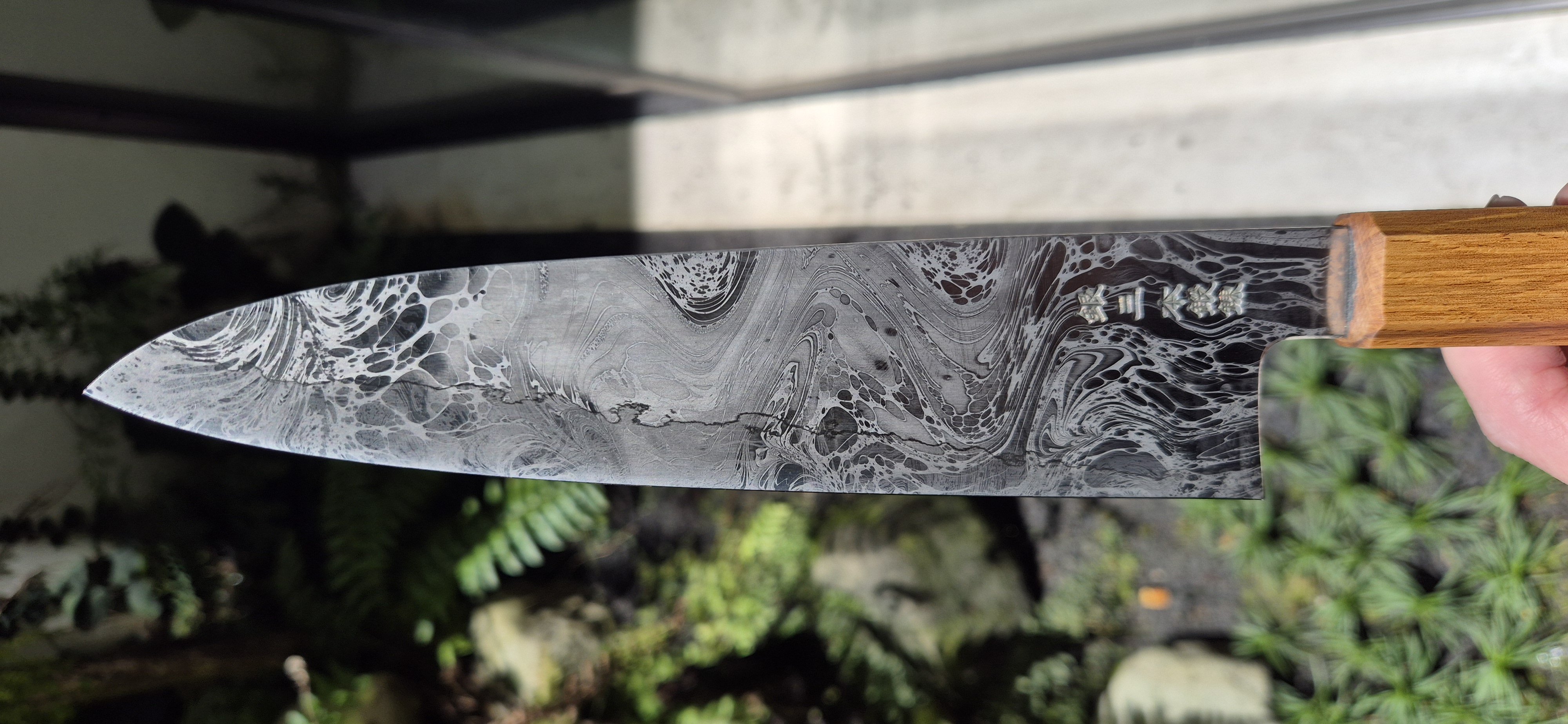
How a Sakai wholesale house's Hado brand and a sales rep turned master sharpener, Tadataka Maruyama, prove the togishi is half the knife.
# Hado and Enjiki: Sakai's Sharpener-Led Knife Story
In Sakai, a blade almost never leaves one workshop. Forging, sharpening, and handle-fitting are traditionally split across separate specialist houses, each blade passed down a chain of hands before it reaches a chef. Hado built its brand on breaking that chain. And the sharpener who defined how a Hado knife is meant to feel later left to build a house of his own. Together, the two stories make the same point from opposite directions: in Sakai, the sharpener is not a finishing step. The sharpener is half the knife.
A wholesale house's own brand
Hado is the in-house brand of Fukui Co., Ltd., a Sakai wholesale house with roughly 109 years behind it. The brand launched in 2019 under the house's sixth generation of leadership, succeeding an earlier house brand, OUL. The name translates loosely to "the road of blades," and it marks a real shift in how the company chose to present its work — not as a wholesaler moving other people's knives, but as a maker standing behind its own line.
What makes Hado unusual is structural. Most Sakai brands coordinate a forge here and a sharpening workshop there. Hado keeps blacksmith, in-house sharpener, and artistic direction under one roof — rare enough in this district that it is treated as the brand's defining trait. That proximity means a smith and a sharpener can go back and forth on a blade directly, instead of a finished forging arriving at a stranger's bench with no way to ask questions.
The smiths behind Hado
Two named smiths carry Hado's carbon and stainless lines. Yoshikazu Tanaka, a recognized Dentō Kōgeishi craftsman, forges Junpaku (a White #1 line running a hard 64 HRC), Sumi (a White #2 kurouchi credited by retailers as an early example of kurouchi finishing in Sakai), Kirisame (a misty-nashiji White #1 finish), and B1D (a Blue #1 damascus). Shōgo Yamatsuka, also Dentō Kōgeishi-recognized, forges the Ginsan line. Two smiths, one house, four distinct carbon and stainless expressions — a small enough team that quality control is close to personal rather than procedural.
The Hado style — and the sharpener who set it
Ask what actually makes a Hado knife feel like a Hado knife, and the answer is not the forging alone. It is a hand-sharpened, thin convex grind on kasumi and kurouchi finishes, with pronounced shinogi work along the blade face — a house geometry rather than an incidental one. That geometry was established by Hado's founding sharpener, Tadataka Maruyama, and is maintained today by current head sharpener Naohiro Nomura. The forge sets the steel. The sharpener sets the knife you actually feel in your hand.
From sales rep to togishi
Maruyama's own path into that role is not the standard apprentice story. He joined the Oul/Fukui operation in his mid-30s as a sales representative and warehouse manager — nowhere near a sharpening bench. Asked to move into sharpening, he had the company fund a two-year single-bevel apprenticeship in Sakai, then taught himself double-bevel sharpening in a single month. He went on to become one of the most praised modern togishi working in the city, a reputation built entirely after a career change most people would consider too late to make.
Enjiki, the second act
Maruyama eventually left Hado to found Enjiki Hamono, his own small Sakai workshop — an amicable departure, not a rupture: he still spends one day a week back at Hado, training the sharpeners who came after him. Enjiki's own output, per community reports, is forged by a Sakai smith the community identifies as Tanaka, in White #2 and Ginsan, finished in both kurouchi and polished presentations. The knives sell direct through Enjiki's own storefront and through retailers including Hamono.nl and Churika, with petty knives running around EUR 211 — a small operation, strongly reviewed, built entirely on one sharpener's reputation carrying forward from the house that trained him.
A candid note
Neither Hado's forging attribution for Enjiki, nor the finer detail of who did what on any given blade, is documented with the certainty a spec sheet implies — Sakai's collaborative structure means credit is genuinely shared, and retailer sourcing is the best available record for some of it. That ambiguity is not a flaw to paper over. It is exactly what this story is about: no single name owns a Sakai knife front to back.
Whether it is a Hado piece carrying Tanaka's or Yamatsuka's forging, or an Enjiki blade shaped by the sharpener who set Hado's house style in the first place, both are worth feeling on your own board before any decision is made. Hagane Reserves holds Sakai work exactly for that — a Reserve period in one Patron's hands at a time.
Picture: Enjiki Migiwa Gyuto by Maruyama San
Hagane Reserves is a premium **Japanese knife rental** in Indonesia — Sakai forge and sharpener craft held for one Patron at a time. See what is currently in the Reserves.