first japanese knife · why japanese knives are special · carving knife private dining · japanese knife rental indonesia · rent japanese knife · omakase at home
Your First Japanese Knife: Why the Whole Table Notices
5 August 2026
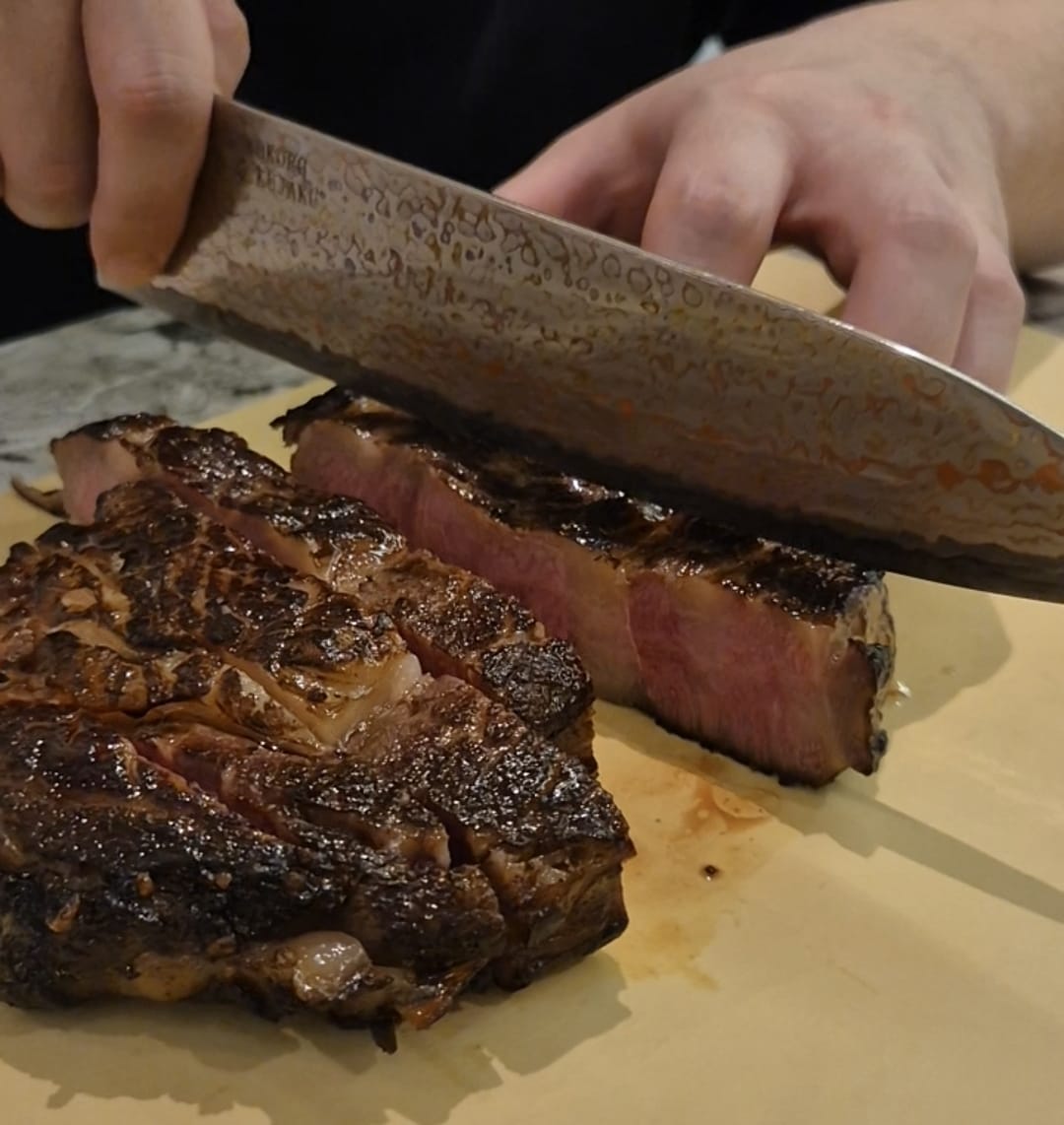
Carving a roast with a real Japanese knife changes a dinner — one pull, one clean face, every eye on the board. Why hosts and private chefs should feel it once.
# Your First Japanese Knife: Why the Whole Table Notices
There is a specific moment almost everyone remembers: the first time a proper Japanese knife is drawn through a rested roast in front of guests. Not the idea of it — the physical act. One long pull, no sawing, and the slice falls away with a face so clean it looks finished, juices held, fibers unbroken, the fat cap glassy. Whoever is nearest the board goes quiet for a second. That moment is the reason this whole craft exists. It is also, honestly, the reason Hagane Reserves exists.
The grind is the magic
What you are feeling in that pull is geometry. A serious Japanese knife is ground almost impossibly thin behind the edge — on the best pieces, a sharpener has spent hours on stones taking the steel down to a taper you can barely measure. Community reviewers call the thinnest of these "lasers", and it is the right word: the knife stops being a wedge you force through meat and becomes a line you draw through it. A sujihiki takes a brisket or a leg of lamb in single pulls, one slice per stroke, every face intact instead of shredded. A side of salmon comes off the skin in one unbroken sheet. A whole chicken opens at the joints as if it had seams. Duck breast slices hold their rosy gradient edge to edge instead of smearing. This is the difference guests can see from across the room — the cut surface itself becomes plating.
Then it just sits there, being beautiful
The second thing everyone notices is that the knife is beautiful in a way kitchen tools are usually not allowed to be. Damascus cladding ripples like water. A hamon — the quench line on a honyaki — drifts along the blade like a mountain ridge in mist. Kurouchi wears its raw forge-black like a work jacket. These finishes are not decoration added at the end; they are the making itself, left visible. Lay one beside the carving board at a dinner party and it does something plates rarely do alone: it makes people lean in before the first slice is even taken.
The patina is the diary
If the piece runs carbon steel, something else happens over the evening: the blade starts to record it. The proteins, the searing juices, the citrus in the glaze — each leaves a faint shadow on the steel, and by the end of service the knife carries a soft grey-blue patina that did not exist when the roast came off the fire. Guests find this either fascinating or mildly alarming, and both reactions are a gift, because now you are telling them about reactive steel, water quenching, and the smith whose name is on the blade — and the dinner has become the kind of dinner people describe to their friends afterwards.
The tasteful flex
Let us be honest about what is happening at that table. Carving is the one act of cooking that has always been performed in front of the audience — from banquet halls to the yakiniku counter — and an exceptional knife turns that moment into the show it was always meant to be. It works the way an exceptional watch or an open bottle of something rare works: it signals care, taste, and a host who sweats the details. But the knife does something the watch cannot — it performs. It is the one status object at the table that earns its place by working, in front of everyone, at the exact moment all eyes are already on the food. For a private chef, the carving pass becomes a signature. For a host running a serious cookout — brisket rested, guests gathered — it is the difference between serving dinner and giving the table something to talk about. That is the flex: quiet, working, undeniable.
Why this became a service
Here is the honest economics: the pieces that produce this moment are collector-level objects. A named smith's honyaki or a licensed swordsmith's damascus can cost as much as the dinner party itself, several times over — and it wants real care: dried after service, oiled before rest, kept away from dishwashers and granite. Owning one is a commitment most hosts, and even many working chefs, are not ready to make for an object that might command a handful of nights a year.
Renting inverts that. You reserve the piece for the dinner that deserves it; it arrives sharp, documented, and cared for; it commands your carving board for the Reserve period; it goes back. The refundable security deposit and the signed agreement protect the piece, a care card travels with it, and the knife returns to the Reserves to be inspected and readied for the next table. You get the carving moment, the conversation, the photographs — without the custody.
Try it once
Our conviction, and the reason this house exists: every host who takes food seriously, and every private chef building a name in Indonesia, should stand behind a truly exceptional Japanese knife at least once — over a rested roast, in front of people who will feel it. Some will go on to buy their own from the makers we write about here; we would consider that a good outcome. The first time, though, is what we are for.
Pieces in the Reserves are held for one Patron at a time, for the length of a Reserve period. If there is a dinner on your calendar that deserves the moment, choose the piece and we will handle the rest.
Hagane Reserves is a premium **Japanese knife rental** in Indonesia — carving moments held for one Patron at a time. See what is currently in the Reserves.