japanese knife rental indonesia · rent japanese knife · hatsukokoro · pisau jepang · japan artisan knife · pisau gyuto · pisau bunka
Hatsukokoro: The Curator Brand Chefs Call Lasers
29 July 2026
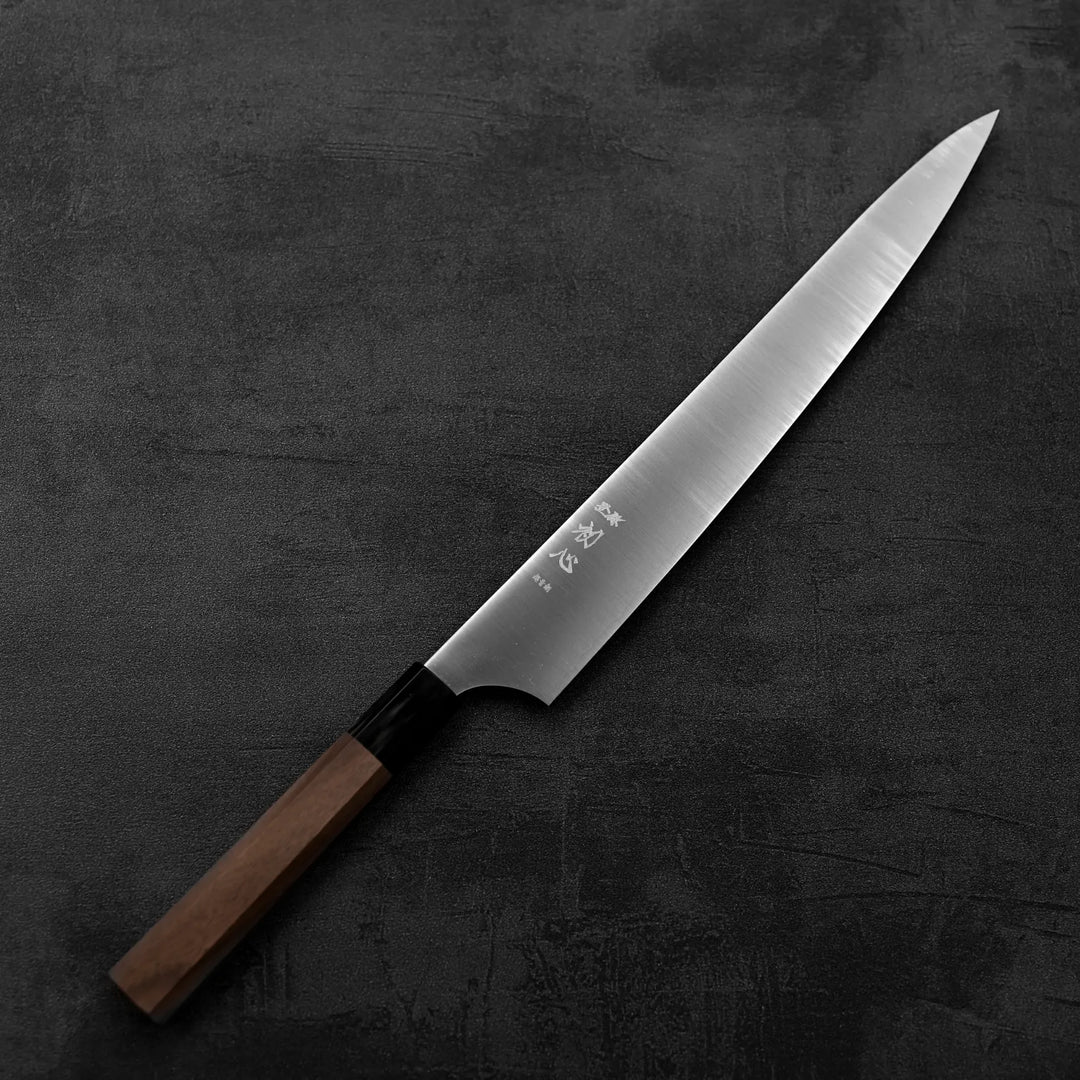
Inside Hatsukokoro's curator model — the Sakai, Tosa, Sanjo and Seki workshops behind its lines, and why chefs call the grind a laser.
# Hatsukokoro: The Curator Brand Chefs Call Lasers
Hatsukokoro does not forge its own knives. That is not a knock — it is the whole model, and understanding it is the key to understanding why the brand has built such a specific reputation among chefs who care about grind quality above almost everything else.
Shoshin, and a network instead of a forge
The name comes from a Japanese proverb, 初心忘るべからず — roughly, "never forget your beginner's heart," the idea of shoshin: approaching craft with the openness of a beginner, no matter how far you have come. H&K Co., Ltd., the company behind the brand, was founded in 2013 as a distributor of Japanese goods. The Hatsukokoro brand itself launched in 2019, built not as a single workshop but as a curated network of blacksmiths, sharpeners, and other traditional artisans spread across Sakai, Tosa, Sanjo, and Seki — four of Japan's most storied cutlery regions, each with its own specialty. Hatsukokoro's job is to select the steel, commission the work, and put its name on the result.
Reading the line landscape
That curator model produces three distinct tiers of transparency, and it is worth knowing which is which before you buy.
Hidden-OEM lines name the steel but not the workshop. This is most of the catalog: Ginrei (Ginsan), Aokitae (Blue #2 kurouchi), Kaijin (Blue #2 stainless-clad — retailers describe it as budget-friendly with performance that punches well above its plain looks), Hikari (SLD), Hayabusa (a tsuchime finish over ATS-34/Ginsan/VG-10), Kurokaze (White #2), Ryuhyo (SG2 damascus), Saihyo (SG2 nickel-black damascus), Ginga (ATS-34 nickel damascus), Kujaku (V-Toku2 rainbow damascus), Hinotori (V-Toku2 rainbow damascus, a higher tier than Kujaku), Yorokobi (SLD kurouchi copper damascus), Hyomon (a White #2 single-bevel yanagiba), and several others including Kokugei, Kurogane, and Shinkiro. You know exactly what steel is in your hand; you are trusting Hatsukokoro's curation for who actually forged it.
Disclosed-maker lines name names. Kumokage, a Blue #2 damascus kurouchi line, is forged by Muneishi Hamono in Tosa. Shirasagi, a White #2 single-bevel line, is sharpened by Myojin. Komorebi, a Blue #1 suminagashi damascus line, has drawn enough community attention that it has its own comparison thread asking whether it is "a better Yoshikane."
Named-craftsman collaborations sit at the top: a Satoshi Nakagawa Blue #1 damascus line, and a joint Nakagawa × Naohito Myojin Blue #1 damascus line pairing a smith with a dedicated sharpener. Retail copy names a wider roster across the brand's collab work — blacksmiths including Nakagawa, Yu Kurosaki, Shiro Kamo, and Yoshikane; sharpeners including Morihiro Hamono and Naohito and Tateo Myojin. Treat that roster as retailer-sourced rather than brand-confirmed, but it points at the caliber of hands Hatsukokoro works with.
One important caution if you go looking further: Hatsukokoro's Ginga line runs ATS-34 nickel damascus. It is a different knife from the famous "Ginga laser" associated with Ashi Hamono — a separate brand entirely. The names collide; the knives do not.
Why "laser" keeps coming up
Search enough kitchen forums and you will see the word repeated across nearly every Hatsukokoro line: laser. Ryuhyo's geometry is often described as a sabre or v-grind without a defined shinogi line, and community reviews reach for phrases like "absolute lasers" and "like cutting with a laser" to describe how thin the edge feels through food. Komorebi draws similar praise — "wicked grind, very thin behind the edge," tapering down to almost nothing at the tip. The general verdict across community and retailer reviews alike: great grind, great heat treat. For a chef doing fine kitchen work — herbs, fish, delicate vegetable cuts — that kind of thinness behind the edge is the difference between a knife that pushes through and one that glides.
A candid note
Curation is not the same as consistency. Community threads on Hatsukokoro do note some sample-to-sample grind variation between individual knives of the same line — a fair trade-off for lines where the workshop itself is anonymous. When you buy most Hatsukokoro pieces, you are trusting the brand's eye, not a single smith's decades-long hand. For a lot of chefs that is exactly the appeal — access to Sakai- and Tosa-level work without needing to already know which smith to look for. For others, it is worth knowing going in.
In the Reserve
Hatsukokoro's range is well represented among the pieces we currently hold: the Ryuhyo Rainbow SG2 kiritsuke gyuto 240mm, the Kujaku V-Toku2 gyuto 240mm, and the Satoshi Nakagawa × Naohito Myojin Aogami #1 santoku, finished with an amboyna handle by Byan Hoja. Each is reserved for one Patron at a time for a Reserve period — a way to put a laser-thin curator-grade edge on your board and feel exactly what the reputation is about.
Hagane Reserve is a premium **Japanese knife rental** in Indonesia — Hatsukokoro pieces like the Ryuhyo and Kujaku held for one Patron at a time. See what is currently in the Reserve.