japanese knife rental indonesia · rent japanese knife · hiromune takaba · takaba knives · seki swordsmith · miyabi damascus · licensed swordsmith knife · honyaki gyuto
Hiromune Takaba: A Licensed Swordsmith's Kitchen Knives
5 August 2026
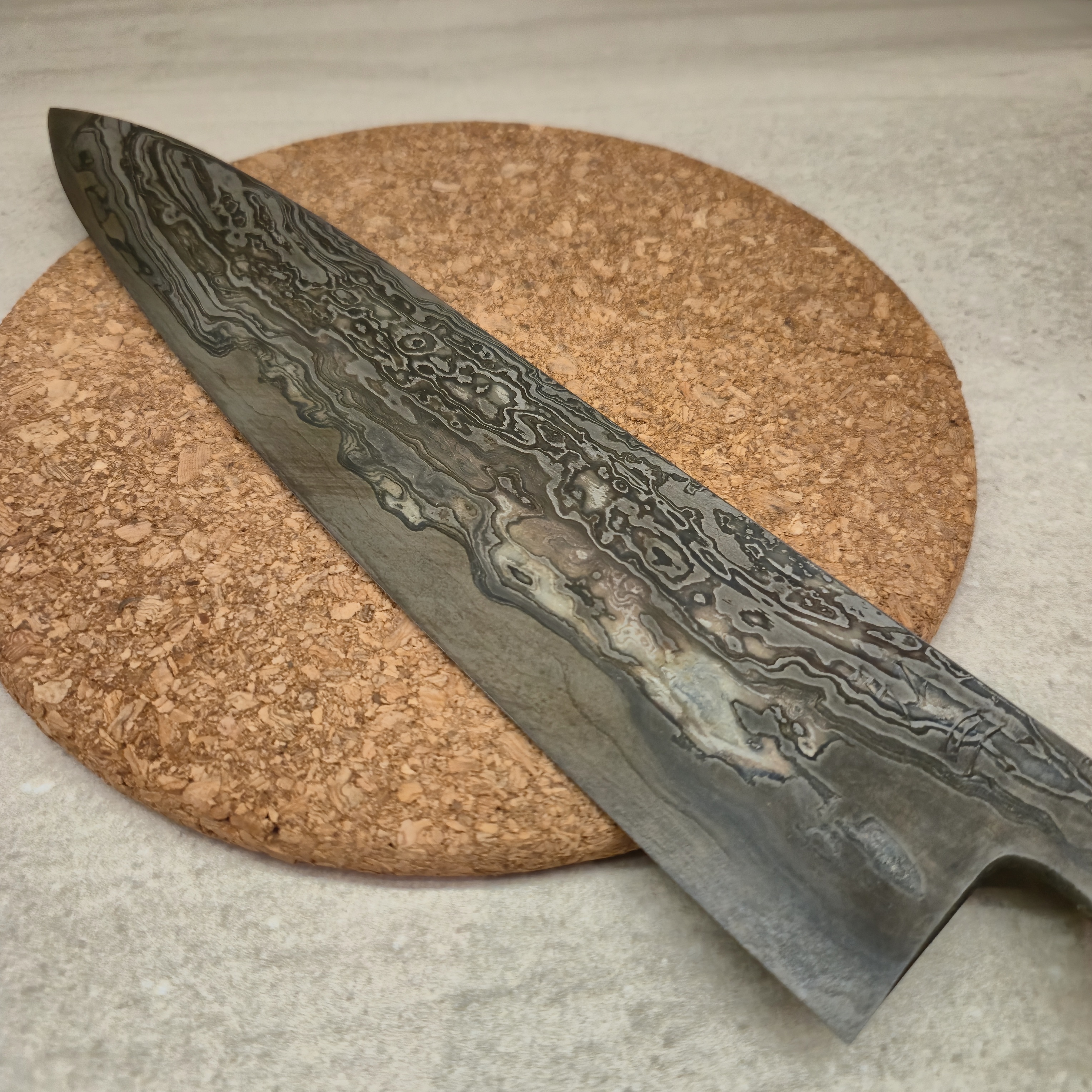
Meet Hiromune Takaba, the licensed Seki swordsmith behind the Miyabi line's in-house laminate damascus kitchen knives.
# Hiromune Takaba: A Licensed Swordsmith's Kitchen Knives
Some kitchen-knife makers describe themselves as heirs to a sword tradition. Hiromune Takaba (高羽弘宗) is one of the smaller number who actually hold the license that word requires. He is a working tōshō — a licensed swordsmith — based in Seki, and his kitchen knives are made by the same hands, and largely the same technique, as his sword commissions.
Who He Is
Takaba was born in 1954 in Seki City, Gifu — the cutlery region that, as we cover in our companion piece on Japan's swordsmith-to-knifemaker history, converted from sword production to edge-tool production after the 1876 Haitōrei edict. He apprenticed in 1973 under his father, Makoto Takaba, and received his own sword license in 1978, after completing the government-registered apprenticeship that licensing requires. His dealers describe his work as sitting in the Sōshū tradition, with some linking it to the Kamakura-era smith Saburō Kaneuji, and record Excellence Awards at the NBTHK New Sword Exhibition in 2000 and 2001. Those attributions come from his retailers' own records rather than an independent registry we can cite directly, so treat the tradition lineage and award history as dealer-recorded rather than independently verified — though the underlying license itself, and the roughly eighteen licensed swordsmiths said to be working in Seki, are well documented.
The Miyabi Line: In-House Laminate Cladding
Takaba's signature kitchen line carries the name Miyabi (雅), and its defining feature is a nickel-added iron laminate cladding that he forges in-house rather than sourcing pre-made. The result is the organic, geological-strata damascus look that the photograph accompanying this article shows on one of his pattern-welded pieces — layered, striated, closer to reading like cross-sectioned rock than a repeating machine pattern. Some retailers note that the cladding iron he works with is a limited stock left to him by his father, which, if accurate, adds a second, quieter layer of scarcity underneath the license itself. The line spans gyuto, sujihiki, yanagiba, and petty profiles, and Takaba also produces art objects through the Seki dealer Yamahide alongside his knife work.
The Tamahagane Question, Handled Honestly
Tamahagane — the traditional smelted steel used in nihonto — comes up often enough around Takaba's name that it deserves its own honest section. Some retailers list stock damascus gyuto models, including a 300mm piece priced above US$3,600, as having a tamahagane core; that is a retailer claim, not something independently confirmed on every knife carrying it, and it should be read that way. Separately, a genuine one-off pure-tamahagane honyaki gyuto, around 255mm, has surfaced through specialist forum classifieds — a real but non-standard piece, not representative of his regular lineup. It is also worth being precise about what the license actually restricts: Japanese law limits who may forge nihonto, not who may purchase tamahagane. A retailer framing tamahagane access itself as a legal exclusivity of licensed smiths is overstating the restriction — the scarcity is in the forging license and the apprenticeship behind it, not in steel procurement.
Collector-Tier Pricing and Scarcity
None of that changes the basic market reality: Takaba's kitchen knives sit at collector-tier pricing, commonly above US$3,600 for a 300mm damascus gyuto, and move through a short list of specialist dealers — Yamahide in Seki, Tosho Knife Arts in Toronto, and Meesterslijpers in the Netherlands. That is a narrow distribution for a maker whose actual sword output is capped by law, and secondary-market demand for his pieces stays active.
The Sword-to-Knife Bridge
Takaba is the clearest living example of the arc our swordsmith-history article traces on paper: a five-year licensed apprenticeship, a government-registered sword practice with a hard monthly cap, and a kitchen-knife line built by the same hands using the same lamination and quenching instincts. Where some brands lean on a sword story from a century or more ago, Takaba's license is current, his forge is active, and the geological-strata cladding on a piece like the one in this article's photograph is the visible result of that discipline applied to a board knife instead of a blade meant for a scabbard.
In the Reserves
A knife carrying this kind of licensed lineage sits, honestly, at collector-tier pricing with collector-tier scarcity behind it. For a private chef or host who wants a piece with a documented, active sword license standing behind the forge, it is a different category from most kitchen-knife stories.
Hagane Reserves is a premium **Japanese knife rental** in Indonesia — licensed-swordsmith pieces held for one Patron at a time. See what is currently in the Reserves.