japanese knife rental indonesia · rent japanese knife · japanese knife finishes · what is kurouchi · kasumi finish · damascus knife · tsuchime · migaki · japanese knife blade finishes
5 Japanese Knife Finishes Explained: What Kurouchi Really Is
29 July 2026
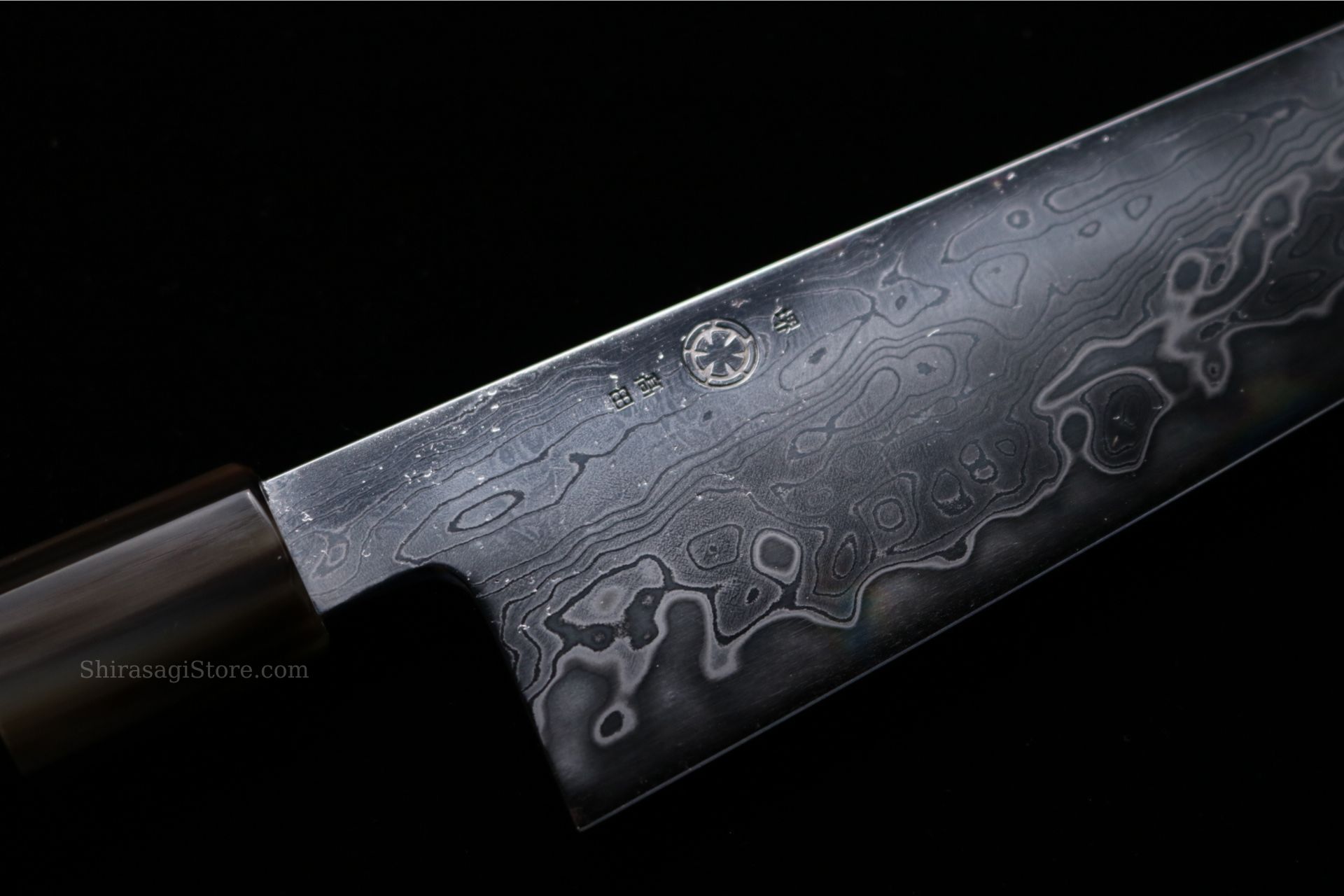
What kurouchi, kasumi, migaki, tsuchime, and damascus actually are, how each is made, and what each does on the board.
# 5 Japanese Knife Finishes Explained: What Kurouchi Really Is
A finish is not decoration on a Japanese knife — or not only decoration. Every one of the finishes below is a byproduct of how the blade was actually made, and each one has a real effect at the board: how food releases off the flat, how much a patina shows, how much labor a smith put in before the knife ever reached an edge.
Migaki — polished bare steel
Migaki is a machine- or hand-polished finish that strips the blade down to bright, bare steel. It takes extra finishing labor over leaving the forge scale on, and the result reads sleek and clean out of the box. The trade-off: bare polished steel has the weakest food release of the group — thin slices tend to cling rather than fall away — and it shows scratches and any developing patina plainly, since there is no texture to disguise wear.
Kasumi — the "mist"
Kasumi means mist, and it names what natural-stone polishing does to a soft-iron-clad blade: the cladding takes on a soft, hazy, matte look while the hard steel core stays bright along the edge. Getting there by hand on natural stones — hon-kasumi — is widely considered the most labor-intensive of the five finishes, and it signals two things at once: traditional awase (clad) construction, and a level of stone-polishing skill that takes years to develop. As a practical bonus, kasumi's misted surface is good at masking a developing patina, so a working blade tends to look presentable for longer between deep cleans.
Kurouchi — the blacksmith's finish
Kurouchi leaves the forge scale — the dark oxide layer that naturally forms during forging — on the blade above the cutting bevel, polishing only the edge itself bright. It is the least labor-intensive of the five to finish, and it reads as an honest, rustic signal of the blacksmith's process rather than a decorative choice. Functionally, that oxide layer protects the covered area from rust and hides wear and small scratches well; it also wears thin gradually with use and handling, which most owners read as character rather than damage. Some modern kurouchi finishes are lacquer-assisted rather than pure forge scale — worth asking about on a specific piece, since the two behave a little differently over time.
Tsuchime — hammered texture
Tsuchime is a hammer-peened texture, dimples struck into the blade face before final grinding. The dimples reduce the actual contact area between the blade flat and whatever is being cut, which measurably improves food release — thin, sticky slices of things like sweet potato or cucumber let go more easily than they would off a flat migaki face. The honest caveat: on a carbon-steel tsuchime blade, moisture can sit in those dimples if the knife isn't dried carefully, so it wants a slightly more attentive wipe-down than a smooth finish does.
Damascus / suminagashi (my favourite) — layered cladding
Damascus construction forges many thin layers of steel around a mono-steel working core, then reveals the layered pattern by etching or polishing. Suminagashi, literally "flowing ink," describes the swirling, wood-grain-like patterns that result. It is worth being clear about what this finish is and isn't: the pattern is cladding cosmetics, not the cutting edge — the mono-steel core inside does the actual work, whether that is shirogami, aogami, V-Toku2, or SG2. The labor here happens earlier than on the other finishes, at the steelmaking and layering stage, before the smith ever shapes a single blade.
Two honorable mentions
Nashiji — a pear-skin forge texture, visually similar in spirit to tsuchime's practical logic: decent food release, low upkeep, an understated rustic look.
Mirror polish — the maximum-labor finish, buffed to a true mirror. It is the most prestige-coded of the group and, being polished bare steel taken further than migaki, also the stickiest for food release of anything here. Some retailers use the term "kyomen" for this finish; "mirror polish" is the clearer, more widely understood term to reach for.
Choosing by what a kitchen actually needs
None of these finishes changes the steel underneath — see our companion articles on shirogami, aogami, SG2, and V-Toku2 for what is actually doing the cutting. What the finish changes is how the knife behaves on the flat: food release for high-volume slicing work favors tsuchime or nashiji texture over migaki or mirror polish; a kitchen that wants low visible wear over months of daily use tends to prefer kurouchi or kasumi over bare polished steel.
Pieces across every one of these finishes move through the Reserve individually, held for one Patron at a time for a Reserve period. Worth a look at what's currently available if a finish and a steel combination has caught your eye.
Hagane Reserve is a premium **Japanese knife rental** in Indonesia — pieces wearing kurouchi through damascus finishes held for one Patron at a time. See what is currently in the Reserve.