Satoshi Nakagawa · Sakai smith · Japanese knife maker · Kenichi Shiraki · Aogami damascus
Satoshi Nakagawa: The Sakai Smith Behind a Blue Steel Damascus Santoku
23 July 2026
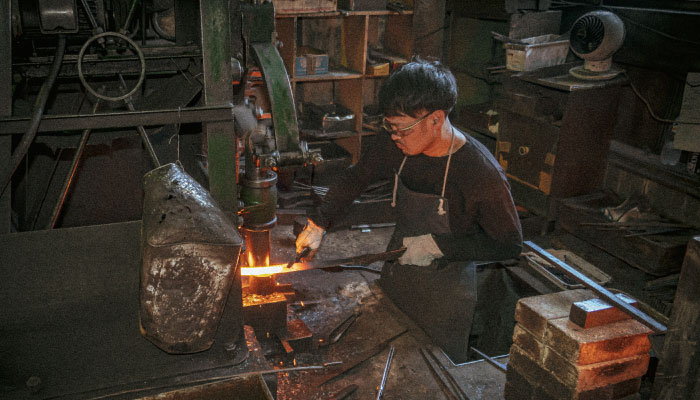
Satoshi Nakagawa is a young Sakai smith trained under Kenichi Shiraki, known for Blue Steel damascus blades forged with precision and patience.
A Craft City's Newest Name
Sakai has forged blades for over six hundred years, and every generation adds a name to that ledger. Satoshi Nakagawa's is one of the newer ones, and among the most closely watched. He came up the traditional way — not through a design school or a marketing plan, but through the long, quiet apprenticeship that Sakai has always demanded of the smiths it keeps.
Sixteen Years Under Kenichi Shiraki
Nakagawa began training at eighteen under Kenichi Shiraki, one of Sakai's respected master smiths. He stayed in that workshop for sixteen years — long enough to absorb not just technique but judgment: how a piece of steel behaves under the hammer on a humid afternoon versus a dry one, when to trust the color of the metal over the clock. When Shiraki's health made it necessary, Nakagawa ran the forge in his place for several years before eventually founding his own workshop, Nakagawa Uchihamono.
That is the part worth sitting with. Sixteen years is not a course. It is most of a career spent learning to do one thing — forge and heat-treat a blade — so well that the result looks effortless. The effortlessness is the tell that the years were real.
The Steel: Aogami and Beyond
Nakagawa works most often in Aogami (Blue Steel) and Shirogami (White Steel), the two carbon steels that define traditional Japanese bladesmithing — steels chosen for the fine, keen edge they take rather than for convenience. He also forges in modern stainless alloys, but the reputation was built on carbon steel: steel that rewards a smith's hand and a Patron's care in equal measure, and that shows, through hardness and grain, exactly how well it was forged.
His blades are known among retailers and knife-literate cooks for consistent geometry and heat treatment — the kind of quiet, repeatable precision that only comes from having forged the same handful of shapes thousands of times. Retailers who have carried his work also note that he was recognized, still relatively young, with the Traditional Craftsman title given to smiths whose technical mastery meets a certain standard of dedication to the trade — worth mentioning as context for how quickly his peers came to trust his hand, though the honor sits alongside the work itself rather than in front of it.
Heat treatment is the part of forging a blade that never shows up in a photograph. Two smiths can start with identical bars of Aogami, hammer them into what looks like the same shape, and end with blades that behave nothing alike at the stone or the cutting board — because the hardening and tempering in between decided how the steel's grain actually set. It is judgment built from repetition, and it is the reason a smith's name on a blade means something specific rather than decorative.
Forging the Blue 1 Damascus Santoku
The piece that brought Nakagawa's name into the Reserves is a santoku built around an Aogami #1 (Blue Steel #1) core, clad in a damascus pattern and finished with a custom amboyna burl handle and matching saya by Hoja. Nakagawa forged the blade and set its heat treatment; the final grind and edge belong to Naohito Myojin, the Tosa-based sharpener whose work appears on some of the most respected blades coming out of Japan today.
That division of labor is the point, not a footnote. A santoku like this passes through two master hands before it is finished — the smith who gives the steel its shape and hardness, and the sharpener who gives it its edge. Neither role is decorative. Both are the craft.
The Maker, Held for a Reserve Period
Satoshi Nakagawa's Blue 1 damascus santoku rests in the Reserves, available to a Patron for a Reserve period — not a purchase, an entrustment. You hold what a sixteen-year apprenticeship and a master sharpener's hand produced, use it at your own table, and return it to the house. Explore the piece and the rest of the collection at Hagane Reserves.