japanese knife rental indonesia · rent japanese knife · SG2 steel · R2 steel · powdered steel · japanese stainless knife steel · SG2 vs VG10 · japanese knife steel
SG2 / R2 Powdered Steel: Powder Metallurgy for Cooks
29 July 2026
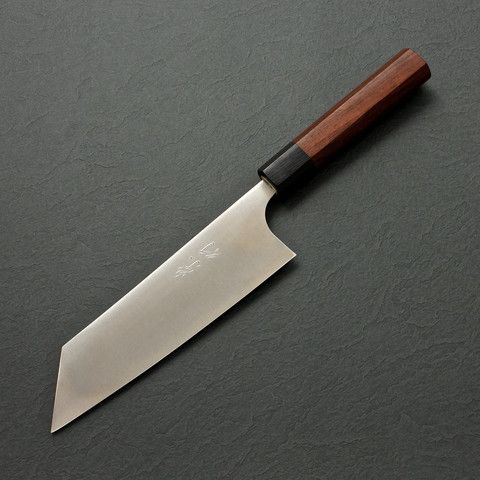
How SG2/R2 powdered stainless is made, why 62-64 HRC stainless holds an edge so long, and where it genuinely struggles.
# SG2 / R2 Powdered Steel: Powder Metallurgy for Cooks
Two names, one steel. Super Gold 2 — SG2 — is the badge Takefu Special Steel distributes it under; R2 is Kobelco's own designation for the same underlying powder-metallurgy steel, credited to Kobe Steel's process. In copy and on spec sheets it is fairest to say "distributed via Takefu" rather than crediting either name as the sole origin — both point at the same material.
What powder metallurgy actually is
Strip away the jargon and it is a fairly intuitive idea. Ordinary steel is cast as a liquid and cooled slowly, which gives large alloy carbides time to clump together unevenly through the metal. Powdered steel skips that: molten steel is atomized into a fine spray of droplets, cooled almost instantly into powder, then compacted and sintered — pressed and heat-fused — back into a solid billet. Because the droplets cool so fast, the carbides inside them stay tiny and spread evenly through the structure instead of clumping. The practical result: a steel that can run harder without turning brittle, because there is no coarse carbide sitting there as a weak point.
What that buys at the board
SG2 carries roughly 1.25–1.45% carbon, 14–16% chromium, 2.3–3.3% molybdenum, and 1.8–2.2% vanadium — fully stainless, and typically run 62–64 HRC. That combination of high hardness and an even carbide structure is why it holds an edge so long; retailer pages commonly cite figures like two to three times the edge life of VG10, though that specific multiplier is a circulating estimate rather than a controlled lab test, so treat it as a directional claim, not a guarantee.
For a kitchen, the appeal is straightforward: carbon-steel-grade retention without the rust discipline carbon steel demands. No daily oiling, no patina to manage, no red rust after a service where the blade sat wet in a bus tub.
Where it genuinely struggles
Here is the honest part. That fine, even carbide structure buys hardness, but hardness and toughness pull in opposite directions, and SG2 sits well toward the hard end. At extreme thinness — a very acute edge angle worked hard against bone, frozen product, or a cutting board edge — it is more prone to micro-chipping than a tougher, lower-alloy carbon steel would be at the same geometry. It is also harder to sharpen than carbon steel: the same fine, dense carbide structure that gives it long service life resists a stone more than shirogami or aogami do, so restoring an edge takes more time and, ideally, a finer sequence of stones.
Who it suits
SG2 fits a pro kitchen that wants long service intervals between sharpenings and zero rust babysitting, and that is not routinely breaking down whole animals or hacking through bone with the same blade. For general prep, proteins, vegetables, and high-volume service, it is close to a set-and-forget edge by Japanese knife standards. For butchery-adjacent work, a tougher carbon steel is usually the better tool.
In the Reserve
The Reserve carries a Hatsukokoro Ryuhyo Rainbow SG2 kiritsuke gyuto, 240mm — an SG2 core dressed in a rainbow-toned damascus cladding, giving that long stainless retention behind a distinctive cosmetic finish. Our companion article on Japanese knife finishes covers what damascus cladding is actually doing on top of a working core like this one.
Pieces built around SG2 move through the Reserve one at a time — held for a single Patron for the length of a Reserve period. Worth a look if a service wants long edge life with minimal upkeep.
Hagane Reserve is a premium **Japanese knife rental** in Indonesia — SG2 pieces held for one Patron at a time. See what is currently in the Reserve.