japanese knife rental indonesia · rent japanese knife · shirogami · white steel · white paper steel · honyaki · hamon · japanese knife steel · shirogami vs aogami
Shirogami White Steel Explained: Purity, Grades, Honyaki
29 July 2026
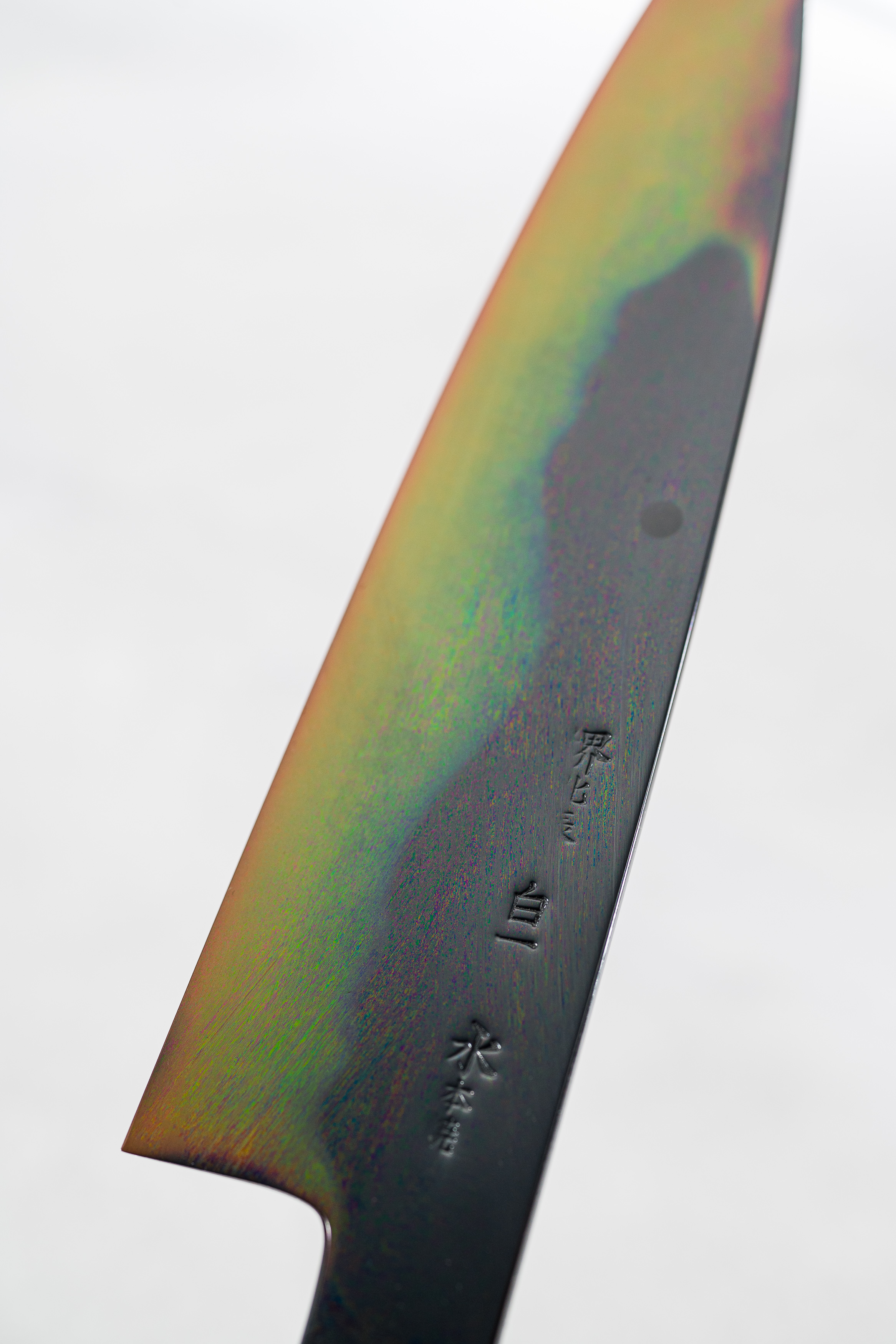
What shirogami (white paper steel) is, why Sakai smiths prize its purity, and what it means to sharpen and care for it in a working kitchen.
# Shirogami White Steel Explained: Purity, Grades, Honyaki
Ask a Sakai sharpener what the purest steel in the case is, and the answer is usually shirogami. Not the hardest, not the toughest, not the one that holds an edge longest through a double shift — the purest. That distinction matters more than it sounds like it should, and it is where this steel's whole reputation is built.
Where it comes from
Shirogami — white steel — is rolled at the Yasugi Works in Shimane, historically under Hitachi Metals and, since a January 2023 rename, under Proterial. The line is called YSS, Yasuki Specialty Steel, and it descends from the tatara tradition of Japanese ironmaking. It is, in a real sense, industrial-era steel carrying a pre-industrial lineage.
Why "white"
Yasugi shipped its steel bars wrapped in colored paper by alloy type: white paper for this line, blue paper for the tungsten-alloyed line covered separately in our aogami article. Sakai smiths picked up the names from the wrapping and they stuck. There is no deeper metaphor in the color — it is a warehouse convention that became an industry vocabulary.
What "purest" actually means
Shirogami carries almost no alloying beyond carbon and iron: phosphorus at or below 0.025%, sulfur at or below 0.004%. Strip out the impurities and you get a very fine, even carbide structure — nothing coarse sitting in the matrix to interrupt the edge. That is the practical payoff of purity: it is not a marketing word here, it is a low-impurity spec that translates directly into how the edge behaves under a stone.
The three grades
Shirogami is graded by carbon content, and carbon content sets the trade-off:
- White #3 — roughly 0.80–0.90% carbon. The toughest, most forgiving of the three, a reasonable entry point.
- White #2 — roughly 1.05–1.15% carbon. The workhorse grade most single-bevel and honyaki knives are built from.
- White #1 — roughly 1.25–1.35% carbon. The hardest to forge well, the most purist, typically run 63–65 HRC by Sakai smiths who know how to handle it.
Lower carbon buys toughness and forgiveness. Higher carbon buys a keener theoretical edge and better retention, at the cost of a smith needing real skill to heat-treat it without cracking the blade. Typical hardness across the family lands 60–64 HRC.
Honyaki and the hamon
Shirogami, usually White #1 or #2, is the canonical steel behind honyaki — mono-steel, water-quenched blades that show a visible hamon, the wavy line marking where the clay-coated spine cooled slower than the exposed edge. Honyaki is demanding and unforgiving work; water quenching a single piece of high-carbon steel without warping or cracking it is a different order of difficulty from the oil-quenched, clad construction most knives use. It is not the only reason shirogami is prized, but it is the clearest showcase of what the steel can do in a smith's hands who has earned the right to try.
Sharpening and edge life — the honest trade-off
Here is the candid part: shirogami is, by consensus, the easiest of the major Japanese knife steels to sharpen to a genuinely scary-sharp edge, and it is also the one that holds that edge for the shortest stretch of service. A chef running a shirogami blade through a long prep shift will feel it dull sooner than a stainless or tungsten-alloyed edge would. That is not a flaw to talk around — it is the deal you make for the easiest, cleanest stone work in the category. Chefs who touch up on a stone daily tend to love this steel. Chefs who want to sharpen once a month and forget about it usually don't.
Living with a reactive steel
Shirogami has essentially no chromium, so it is fully reactive carbon steel — it will patina, and it will rust if you let it sit wet. In a working kitchen that means: wipe it dry immediately after every use, keep a light film of oil on it in storage, and let a stable grey patina build rather than scrubbing it back to bright steel every time. A patina is not damage; a patina is the steel's own protection layer forming. Neglect, on the other hand, gets you red rust fast — that part is on the user, not the steel.
For the finishes that often accompany a shirogami edge — kasumi's misted cladding, kurouchi's raw forge scale — see our companion piece on Japanese knife finishes, which covers what each surface is doing for the steel underneath.
Pieces built around shirogami move through the Reserve individually — held for one Patron at a time for the length of a Reserve period. If a purist, stone-friendly edge is what a service calls for, it is worth a look at what is currently available to reserve.
Hagane Reserve is a premium **Japanese knife rental** in Indonesia — shirogami pieces held for one Patron at a time. See what is currently in the Reserve.