japanese knife rental indonesia · rent japanese knife · honyaki · japanese swordsmith history · licensed swordsmith knife · tosho · seki knives · sakai knives history
From Swordsmiths to Knifemakers: A Japanese Craft History
5 August 2026
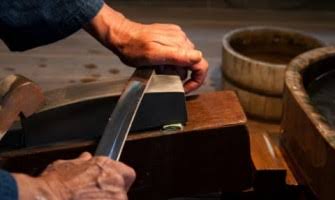
How Japan's swordsmiths became kitchen-knife makers — the 1876 sword ban, the postwar license system, and honyaki's sword roots.
# From Swordsmiths to Knifemakers: A Japanese Craft History
Most of the sharpest kitchen-knife traditions in Japan today were, at some point, sword traditions first. That is not marketing shorthand — it is a specific, dated history, and understanding it is the difference between reading "sword lineage" on a listing as a fact and reading it as a story a brand tells about itself. Some of it is verifiable. Some of it is homage. This is the version with the dates attached.
1876: Haitōrei and the Collapse of Sword Demand
In 1876, the Meiji government issued the Haitōrei edict, banning the carrying of swords by anyone outside the military and police. Almost overnight, the market for nihonto — the traditional Japanese sword — collapsed. Smiths in Seki, Sakai, Echizen, and Tosa, regions that had built generations of skill around lamination, differential hardening, and stone finishing, had to find somewhere else to put that skill. Kitchen and edge tools were the answer. Seki, in particular, converted so thoroughly that it is now counted among the world's three great cutlery-producing regions — a direct line from a banned craft to a global one.
The Postwar License: Why a Swordsmith's Kitchen Knife Is Scarce
Sword forging did not simply continue quietly after 1876 — it went through a second, harder interruption. During the Allied occupation, GHQ imposed a near-total ban on sword production from 1945 to 1953. When the ban lifted, Japan did not return to open forging; it replaced it with a licensing system that is still in force. To forge nihonto legally today, a smith has to complete roughly a five-year apprenticeship under a licensed master, register with the authorities, and then work within a production cap — commonly cited as around two long swords a month, alongside a slightly higher allowance for shorter blades. Every blade produced is registered.
That is the part worth sitting with when a kitchen knife is described as coming from a licensed swordsmith. It is not a marketing flourish — it means the maker cleared a genuinely restrictive, government-registered apprenticeship and production system built for an entirely different object, and is now applying that same hand to a knife that will see a cutting board instead of a scabbard. The scarcity is structural, not invented.
Honyaki: Sword Technique on a Kitchen Board
The clearest technical bridge between the two crafts is honyaki. A honyaki kitchen knife is mono-steel rather than laminated, coated in a clay slurry before quenching so that the edge cools faster than the spine, and water-quenched rather than oil-quenched — the harder, less forgiving version of differential hardening. The result is a visible hamon, the wavy hardening line that is the signature mark of a traditional Japanese sword, now running down a gyuto or yanagiba instead of a katana. The term itself comes directly from sword-making practice. When a maker's honyaki work is described as sword technique living inside a kitchen knife, that is not a figure of speech — it is the same metallurgical process, applied to a different shape.
Lineage Stories: Homage vs History
Here is the candid note this history deserves: not every "sword lineage" story printed on a knife brand's About page is documented history. Some of the most-repeated brand narratives do not hold up well under a close look. Sakai's real craft arc, for instance, runs through tumulus-era ironwork into 16th-century gunsmithing and tobacco-knife production — guns, not swords, are the actual bridge into Sakai's kitchen-knife industry, with brands like Sasuke tracing directly back to gunsmith roots. Other well-known houses simply post-date any sword era entirely: Masamoto was founded in 1845 Tokyo with no sword lineage attached, and some multi-century origin stories — Kikuichi's often-cited 750-year, Emperor Go-Toba connection among them — are effectively unverifiable company history rather than documented lineage.
Aritsugu is the more solid case: founded in 1560 by Fujiwara Aritsugu as a supplier to the Imperial court, the brand's shift from swords to cutlery during the Edo peace is one of the better-supported versions of this story in the record. The honest takeaway is not that sword-lineage claims are worthless — it is that they deserve the same scrutiny as any other brand history, and a story being repeated often is not the same as a story being documented.
Modern Licensed Smiths Making Knives
The living version of this bridge is not just historical — it is active today. Hiromune Takaba, a licensed swordsmith working in Seki, builds kitchen knives alongside sword commissions, and we cover his work and the Miyabi line in a dedicated maker spotlight. Moriya Munemitsu is another modern licensed smith whose kitchen work carries the same restrictive apprenticeship behind it. When a listing names a specific licensed smith rather than gesturing at "sword heritage" in general, that is usually the difference between a documented craft lineage and a marketing story.
In the Reserves
A knife forged by a licensed swordsmith carries a different kind of scarcity than a factory line — not because of a story on a box, but because of an apprenticeship and a production cap that predate the knife itself.
Hagane Reserves is a premium **Japanese knife rental** in Indonesia — pieces forged by licensed swordsmiths held for one Patron at a time. See what is currently in the Reserves.