japanese knife rental indonesia · rent japanese knife · pisau tojiro · merk pisau jepang terbaik · rekomendasi pisau jepang · VG10 · best value japanese knife brand
Tojiro: Inside the Tsubame-Sanjo Workhorse Brand
29 July 2026
How Tojiro went from farm equipment to a chef's first VG10 gyuto — the Tsubame-Sanjo factory story and full line hierarchy, explained.
# Tojiro: Inside the Tsubame-Sanjo Workhorse Brand
Ask a working chef which Japanese knife brand put a proper VG10 gyuto within reach of a line cook's budget, and Tojiro comes up before almost anyone else. It is not the flashiest name in the drawer. It is the one that is actually in the drawer — at culinary schools, in commercial kitchens, in the first knife roll of cooks who later graduate to custom work. Understanding why starts in Tsubame-Sanjo, Niigata, the district that has shaped Japanese metal for generations.
From farm equipment to the forge
Tojiro's story does not begin with a blacksmith's family lineage. It begins in May 1953, when the company was founded in Tsubame as Fujitora Farm Equipment — making machine parts and blades for agricultural tools. Knife production only started in April 1955, added to offset slow winter sales of farm equipment. The company was renamed Fujitora Industry in 1964, and finally became TOJIRO Co., Ltd. in July 2015. Some retailers list 1955 as the founding year, which is really the start of knife-making, not the company itself.
That agricultural, industrial-metalworking origin matters. Tsubame-Sanjo is Japan's metalworking and cutlery heartland, and Tojiro built its knife operation as one integrated factory — production is handled in-house, start to finish, under a single roof. That is a real contrast to Sakai, where forging, sharpening, and handle-fitting are traditionally split across separate specialist workshops passing a blade down the line. Neither model is superior on its face, but Tojiro's is why the brand can hold consistent quality at volume and at a price rivals struggle to match.
Tojiro also opened its doors to the public. The TOJIRO Open Factory — a gallery, working factory floor, and a "Knife Atelier" — opened in July 2017, with galleries following in Tokyo (2023) and Osaka (2024). Visitors can watch the knives get made. Few knife brands anywhere offer that kind of transparency.
Walking the line, entry to atelier
Tojiro's catalog is a genuine hierarchy, not just a size chart. Roughly low to high:
- Fujitora — a sister brand from the same factory, sold through reseller channels at the most accessible price point. It is not a Japan-only budget label, despite what some listings imply.
- Tojiro Basic / Basic Damascus — the entry clad line: a three-layer construction with a VG10-class core.
- Tojiro Color / MV — a molybdenum-vanadium mono-steel line with HACCP-coded color handles, built for commercial kitchens that color-code by station.
- Tojiro DP, now branded TOJIRO CLASSIC on the official site (most retailers still sell it as "DP") — this is the line that built the brand's reputation: a VG10 core, three-layer clad construction, bolstered Western handle. It is the knife most cooks mean when they say "I started on a Tojiro."
- DP/CLASSIC Damascus — the same VG10 core wrapped in 37 layers of damascus cladding.
- Zen / Zen Black — a three-layer VG10-class ("cobalt alloy") line on a wa-handle, with Zen Black finished kurouchi-style.
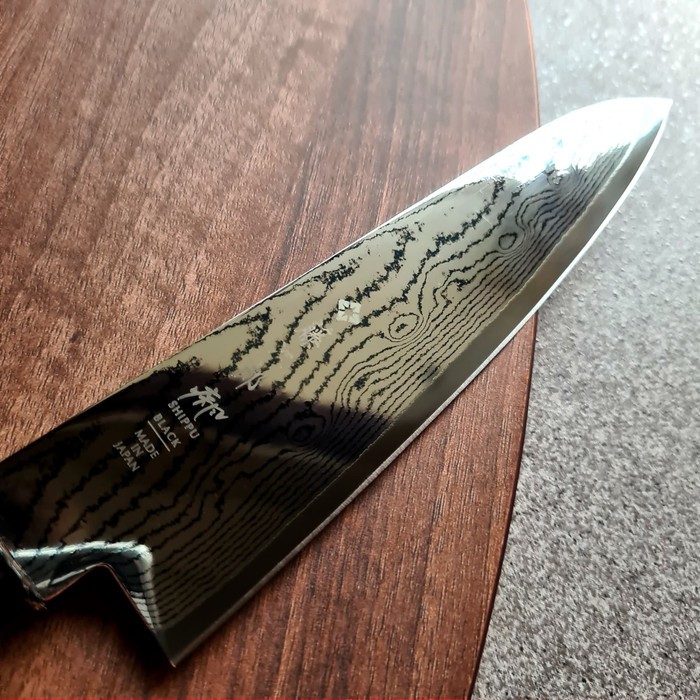
- Shippu / Shippu Black — a 63-layer damascus line, with the Black variant reported by retailers to run Aogami #2 kurouchi. It has faded from Tojiro's current official series pages, apparently superseded by newer lines like Reppu, Sakuya, Ouran, Gai, Hammered, and Shirogami.
- Flash — a VG10 core under 63-layer damascus, on a modern micarta-style handle.
- Pro — an all-stainless, integral-handle line built for sanitation-first professional kitchens, still on DP-class VG10.
- Origami — a single sheet of steel folded into a knife with no welds, an iF Design Award winner and one of the more unusual pieces of engineering in the catalog.
- TOJIRO ATELIER — the top of the line: a small in-house artisan workshop producing 63-layer hand-forged damascus over VG10. Retailers attribute individual knives to specific smiths, with Tomoo Matsumura named in that attribution, though that credit line is best treated as retailer-sourced rather than confirmed by Tojiro directly.
Tojiro does not currently offer a honyaki line — Atelier is the effective ceiling.
Why chefs start here
Ask around any professional kitchen and Tojiro DP is usually the answer to "what was your first real Japanese knife." Genuine VG10 steel, sharpened well out of the box, at roughly half the price of comparable rivals — that is the value case reviewers keep making, and it holds up. The Pro line extends that logic into hygiene-first commercial settings with an all-stainless build that survives a wash-down. Whether Tojiro is truly "culinary-school standard" is the kind of claim that shows up often but is hard to pin to a single source — treat it as a strong, widely repeated reputation rather than a verified fact.
For Indonesian chefs, Tojiro is not a grey-market brand. Upscale Living Indonesia is listed as the brand's official Indonesian distributor, which matters if authenticity is a concern — and in a market where "asli" and "original" are genuine search anxieties, that official channel is worth knowing about.
A candid note
Tojiro's strength is consistency at scale, not individual-smith romance. If what you want is a named craftsman's hand on your blade, look toward Atelier or toward houses like Hatsukokoro's disclosed-maker lines. If what you want is a knife that holds an edge through a double shift and does not ask your budget to bend, Tojiro is exactly built for that job — and it says so honestly, without pretending to be something it is not.
If you want to put a Tojiro-caliber VG10 workhorse — or something further up the ladder — through its paces before committing to your own, a piece from the Reserve can be held for one Patron at a time for a Reserve period. Reach out and we will match the steel to your board.
Hagane Reserve is a premium **Japanese knife rental** in Indonesia — curated pieces across brands held for one Patron at a time. See what is currently in the Reserve.