sakimaru takobiki · kiritsuke knife · honyaki hamon · unusual japanese knife shapes · japanese knife rental indonesia · rent japanese knife
Unusual Japanese Knife Shapes That Perform
3 August 2026
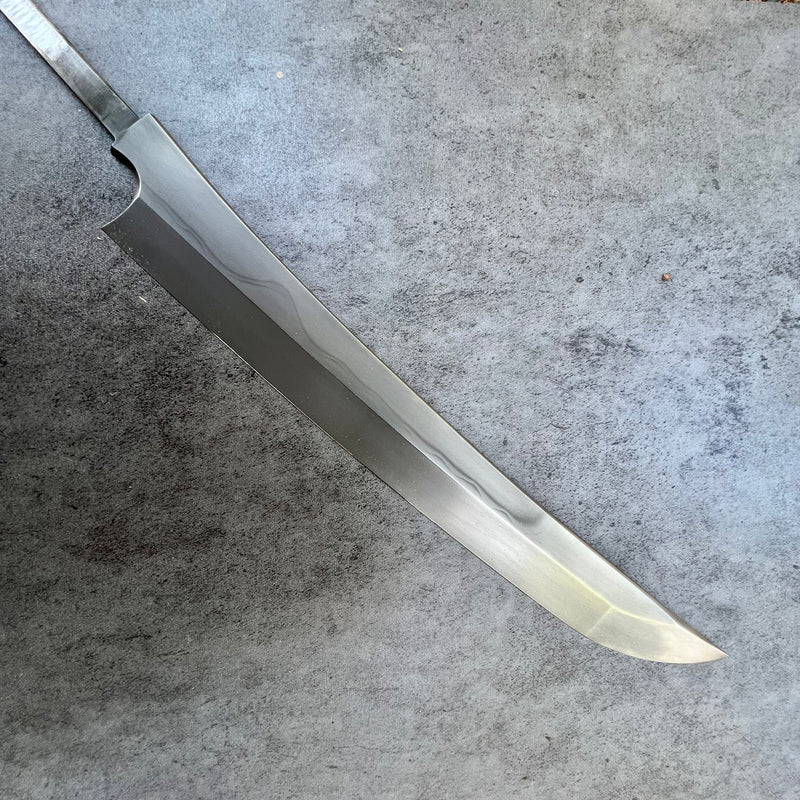
Sakimaru takobiki, kiritsuke, honyaki hamon — the dramatic Japanese knife profiles built to command a counter, and the honest story behind each.
# Unusual Japanese Knife Shapes That Perform
Some Japanese knives exist to do a job. A smaller number exist to do a job while looking like nothing else on the pass — long, curved, or carrying a visible hamon that catches light every time the blade turns. These are the profiles that perform, in the theatrical sense, at the counter as much as on the board. Here is the honest story behind each.
Sakimaru takobiki — the katana-look knife
The sakimaru takobiki is the most dramatic silhouette in the sashimi world: long, narrow, with a gently rounded, sword-like tip that gives it an unmistakable katana profile on the board. It's built for pull-slicing — a single long draw through a fillet — and high-end sushi chefs favor it for exactly the reason it looks the way it does: the curved tip clears the cutting surface cleanly on the follow-through, and the profile makes a long release stroke feel natural rather than forced. Premium honyaki versions of the sakimaru takobiki are the showpieces of the category, and it's worth being precise about what this knife is not: fugu preparation uses a separate, distinctly thinner blade called the fugu-hiki, not the sakimaru takobiki. They share a family resemblance and get confused often, but they are built for different fish and different tolerances.
Kiritsuke — the head-chef knife, honestly told
No knife in the Japanese lineup carries more lore than the kiritsuke. The story told around it — that only the head chef of a kitchen may carry one — is genuinely part of the culture, and it's a good story. But it's custom, not rule, and the honest version of that story is more interesting than the myth: a kiritsuke's angled tip lets a single blade cross into both usuba (vegetable) and yanagiba (sashimi) territory, which historically made it a mark of a cook trusted with the full range of a kitchen's precision work. That trust, not a title, is what the reputation was actually built on. Today the kiritsuke shape shows up in two forms worth telling apart: the true single-bevel kensaki kiritsuke, which we cover in our companion piece on single-bevel Japanese knives, and the double-bevel kiritsuke-gyuto, or k-tip, which has become a fashionable executive-chef silhouette on gyuto-style blades — covered in our piece on double-bevel Japanese knives. Both carry the tip; only one carries the traditional single-bevel technique behind the lore.
Honyaki — the flagship craft flex
If the sakimaru takobiki and kiritsuke are about profile, honyaki is about process. Honyaki blades are differentially water-quenched monosteel, made using the same technique swordsmiths use on katana — a harder edge, a softer spine, and a visible hamon line where the two meet, the direct fingerprint of that quench. It is the most demanding, most failure-prone method a smith can choose, which is exactly why a successful honyaki piece is treated as the flagship of a maker's range. Genkai Masakuni's mizu-honyaki work is a live example of the technique done at a high level — water-quenched, Sakai-tradition trained, forged in Kyushu, and carrying a hamon that is the visible record of a genuinely difficult process rather than a decorative etch.
What the theater is actually for
It's tempting to treat these three — sakimaru takobiki, kiritsuke, honyaki — as pure spectacle, and at a sushi counter or an open kitchen, spectacle is part of the honest appeal. But the drama isn't decorative on its own: the sakimaru's curved tip serves the pull-slice, the kiritsuke's dual-purpose tip served a working chef's need to cover two disciplines with one blade, and honyaki's hamon is the visible evidence of a harder edge, not just a pattern. These are knives that perform at the counter because the shape was solving a real problem first.
The honest note
Not every kitchen needs a knife this dramatic, and a honyaki blade in particular demands respect: the same hard edge that gives it its performance also makes it more brittle and less forgiving of an off-angle strike or a dropped block than a standard laminated blade. These are pieces for a chef who already has the fundamentals down, not a first Japanese knife.
Hagane Reserves carries pieces from this dramatic end of the craft, including the Hatsukokoro Ryuhyo Rainbow SG2 kiritsuke gyuto 240mm. Reserving a showpiece for a single event or a full Reserve period means it's held for one Patron at a time — no split custody, no guesswork about condition when it arrives.
Hagane Reserves is a premium **Japanese knife rental** in Indonesia — sakimaru takobiki, kiritsuke, and honyaki pieces held for one Patron at a time. See what is currently in the Reserves.