japanese knife rental indonesia · rent japanese knife · usuba · katsuramuki · kamagata usuba · edo usuba · mukimono · single bevel knife · urasuki
Katsuramuki and the Usuba Family Explained
3 August 2026
What katsuramuki is, why the usuba's flat single-bevel face makes it possible, and the usuba variants a chef should know.
# Katsuramuki and the Usuba Family Explained
Hand a washoku apprentice a daikon and a knife and ask for katsuramuki, and you will see the whole discipline of Japanese vegetable work in one motion. The daikon is rotated against the blade while the edge shaves a single continuous sheet off its surface — thin enough to read a hand through, unbroken from first cut to last. It is not a party trick. It is the benchmark training exercise for washoku cooks, and it is built entirely around one knife: the usuba.
What Katsuramuki Actually Tests
The cut looks decorative — the resulting sheet is often rolled and julienned into katsuramuki-based garnishes — but what it is really testing is control. The cook has to hold a constant angle, a constant thickness, and a constant pressure while the vegetable itself is turning, not the blade. Any wobble shows up immediately as a tear or a thick patch in the sheet. Sharpening schools treat sheet evenness and translucency as a direct read on a cook's blade control, which is why katsuramuki shows up early and often in vegetable-station training.
Why the Usuba Makes It Possible
A gyuto or nakiri could, in principle, attempt the same cut, but in practice almost nobody does it that way, and the usuba's construction is the reason. The usuba carries a single bevel — one ground face on the front, and on the back, a shallow concave hollow called urasuki rather than a second bevel. That flat, unbeveled back face is what lets the blade register flush against the daikon's surface as the cook advances it, rather than wedging into the flesh the way a double-bevel edge would. A double-bevel knife has two angled faces pushing the vegetable apart on both sides; a usuba has one face doing the cutting and one face doing nothing but riding flat against the surface. This is the standard trade explanation for why the usuba owns katsuramuki, and it holds up in practice — though it is worth saying plainly that it is craft consensus passed down through sharpeners and chefs, not something anyone has measured in a lab against a double-bevel nakiri. Take it as informed trade knowledge, not physics.
The Usuba Family
The usuba is not one knife but a small family, split first by region. Edo usuba, the Kanto (Tokyo) form, carries a square nose and a flat spine — an unforgiving, purposeful profile. Kamagata usuba, the Kansai (Osaka/Kyoto) form, rounds the spine into a sickle-like curve, which softens the tip and makes close, in-hand peeling work a little safer to control. Mukimono is the family's smaller sibling: a compact, square-nosed peeling and garnish knife built for detail cutting rather than full sheets of daikon. There is also kenmuki, sometimes called ken-usuba — a pointed, sword-tipped peeling variant that shows up occasionally in older references and specialist retailer catalogs. It is genuinely obscure next to the Edo and kamagata forms, and we would not want to overstate how commonly it is actually used today; treat it as a documented but minor branch of the family rather than a standard tool.
Apprentice Lore
Kitchen lore around the usuba station is consistent enough across chef interviews and cooking-school accounts to repeat, with the usual hedge that it is culture rather than measured fact: apprentices are said to spend daily, sometimes years-long stretches at the vegetable board practicing katsuramuki before they are trusted anywhere near the fish station. The story goes that a cook's daikon sheet — its evenness, its translucency, whether it holds together end to end — was for a long stretch of washoku training treated as a more honest test of hand control than anything done with a live fish. Whether or not every kitchen still runs it that strictly, the exercise itself remains a real, still-practiced benchmark.
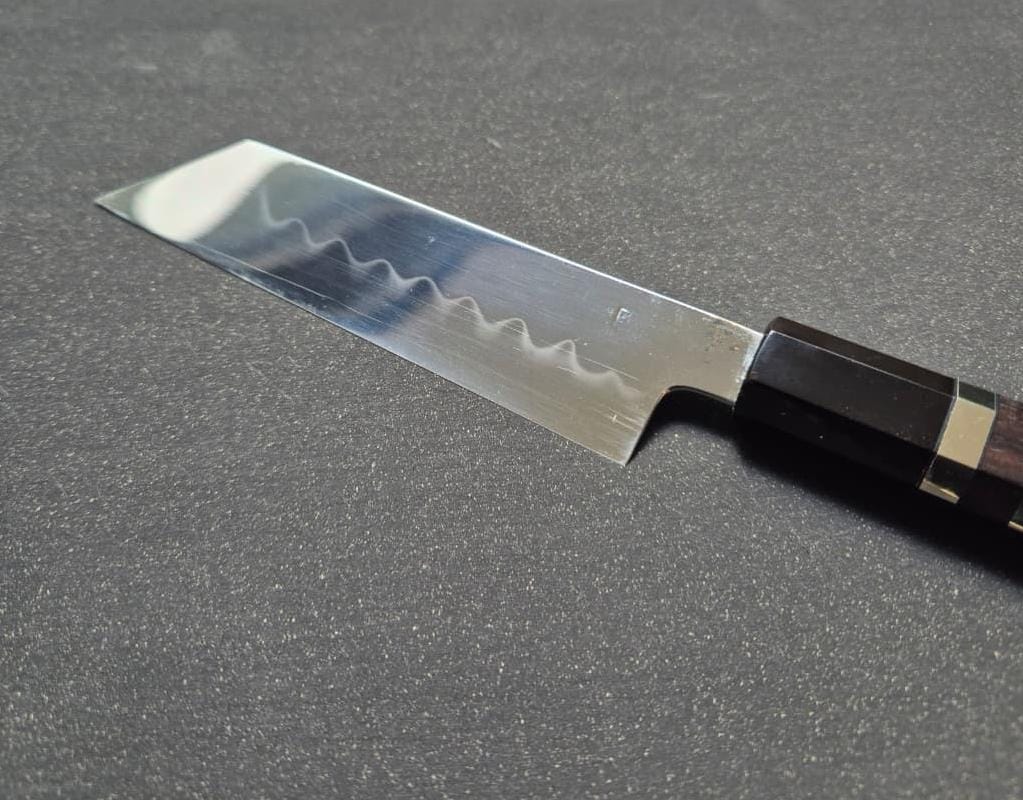
A Genkai Masakuni in the Reserves
The photograph accompanying this piece is a Genkai Masakuni — the brand carried by the smith Mukai Yoneo, the only apprentice trained directly under Masakuni Okishiba. Genkai Masakuni is best known for mizu-honyaki work: differentially water-quenched, single-bevel blades finished with a visible hamon, made in the Sakai tradition but forged out of Karatsu, in Saga prefecture, Kyushu, rather than Sakai itself. It is the kind of single-bevel craftsmanship that makes the urasuki-and-flat-face logic behind katsuramuki visible in the steel, not just explained in a training manual.
In the Reserves
A usuba earns its place on a board the same way it earns its place in an apprentice's training — through repetition, not spectacle. For a private chef or show chef building precision vegetable work into a service, an Edo or kamagata usuba brings that single-bevel control to daikon, carrots, and root vegetables the way a yanagiba brings it to fish.
Hagane Reserves is a premium **Japanese knife rental** in Indonesia — usuba and single-bevel vegetable knives held for one Patron at a time. See what is currently in the Reserves.