japanese knife rental indonesia · rent japanese knife · v-toku2 · v-toku2 steel · takefu steel · japanese knife steel · blue steel alternative · kurouchi gyuto
V-Toku2 Steel Explained: Takefu's Tungsten Carbon Steel
29 July 2026
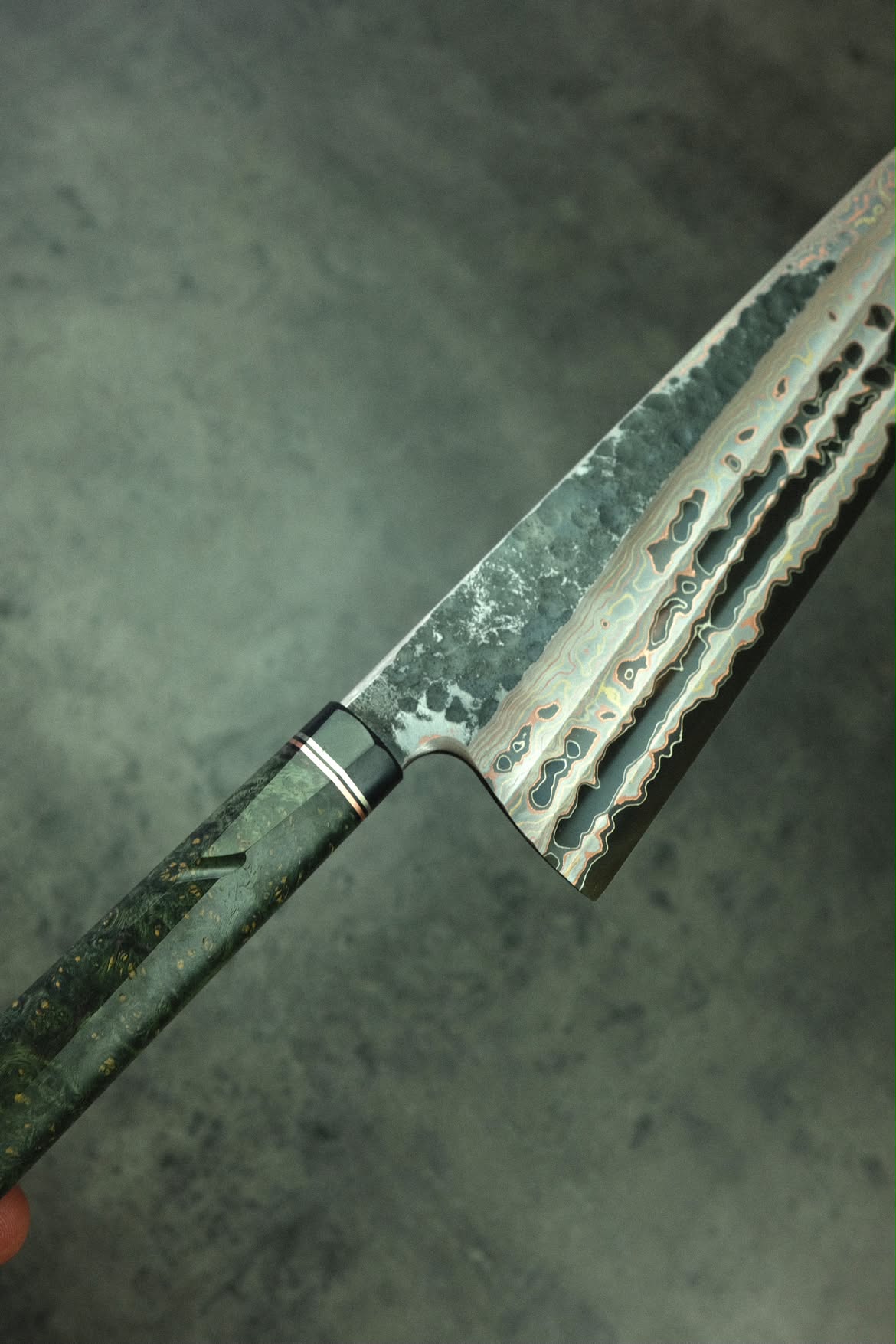
What V-Toku2 is, how it compares to Blue #2, and what it takes to keep this carbon edge working through service.
# V-Toku2 Steel Explained: Takefu's Tungsten Carbon Steel
V-Toku2 sits in a smaller lane than shirogami or aogami — it doesn't carry the same centuries-deep naming story — but for a cook it solves the same problem those steels solve, from a different steelmaker.
What it is
V-Toku2 is one of Takefu Special Steel's "V-series" tungsten-alloyed carbon steels: roughly 1.05% carbon, 1.0–1.5% tungsten, 0.2–0.3% chromium, and a trace of vanadium under 0.2%. It is not stainless — that chromium figure is far too low — so it lives under full carbon-steel care rules, the same as shirogami and aogami.
Retailers and makers commonly position it as Takefu's answer to Blue #2, our companion article on aogami covers that steel's own tungsten-and-chromium formula from Yasugi. V-Toku2 typically runs 62–64 HRC and is generally described as offering a keen, easy edge backed by tungsten-carbide wear resistance. Some retailer copy claims edge life "near Aogami Super with less chipping" — that comparison is a retailer characterization rather than a lab result, so it is worth reading as informed marketing language rather than a settled fact.
What it feels like in service
The tungsten carbide gives V-Toku2 real wear resistance without pushing hardness to the point where the edge gets fussy. In practice that tends to read as: sharpens relatively easily for a carbon steel of its hardness, holds a working edge respectably through service, and does not demand the most advanced stone technique a cook owns. It is a sensible middle step for a kitchen that wants more than shirogami's short retention but doesn't need to chase Aogami Super's outright hardness.
Care
Because it is full carbon steel, V-Toku2 needs the same discipline as shirogami and aogami: dry it immediately after use, keep it lightly oiled in storage, and let a stable patina form rather than fighting it back to bright steel every time. Left wet, it will rust like any reactive high-carbon steel — that part of the deal never changes regardless of which steelmaker's carbon alloy is under the cladding.
Where you'll see it
V-Toku2 shows up most visibly as the working core inside Hatsukokoro's Kujaku and Hinotori lines, both of which wrap the V-Toku2 core in copper, brass, or stainless "rainbow damascus" cladding. It is also sold as bar stock to Western makers building their own knives, so the steel turns up outside Japan-branded lines as well.
In the Reserve
The Reserve carries a Hatsukokoro Kujaku V-Toku2 gyuto, 240mm — a working V-Toku2 core inside Kujaku's distinctive cladding, built for a cook who wants tungsten-backed wear resistance without stepping fully into Aogami Super territory. For the cladding and finish work on a piece like this, our article on Japanese knife finishes covers what damascus and rainbow claddings are doing cosmetically and functionally on top of the core.
Pieces built around V-Toku2 move through the Reserve individually, one Patron at a time for a Reserve period. Worth a look for a kitchen wanting an easy-sharpening carbon edge with genuine wear resistance behind it.
Hagane Reserve is a premium **Japanese knife rental** in Indonesia — carbon-steel pieces like the Kujaku held for one Patron at a time. See what is currently in the Reserve.