japanese knife rental indonesia · rent japanese knife · honyaki · hamon · Sakai knife maker · shirogami vs aogami
Yoshikazu Ikeda: Sakai's Honyaki Master, Still Forging
5 August 2026
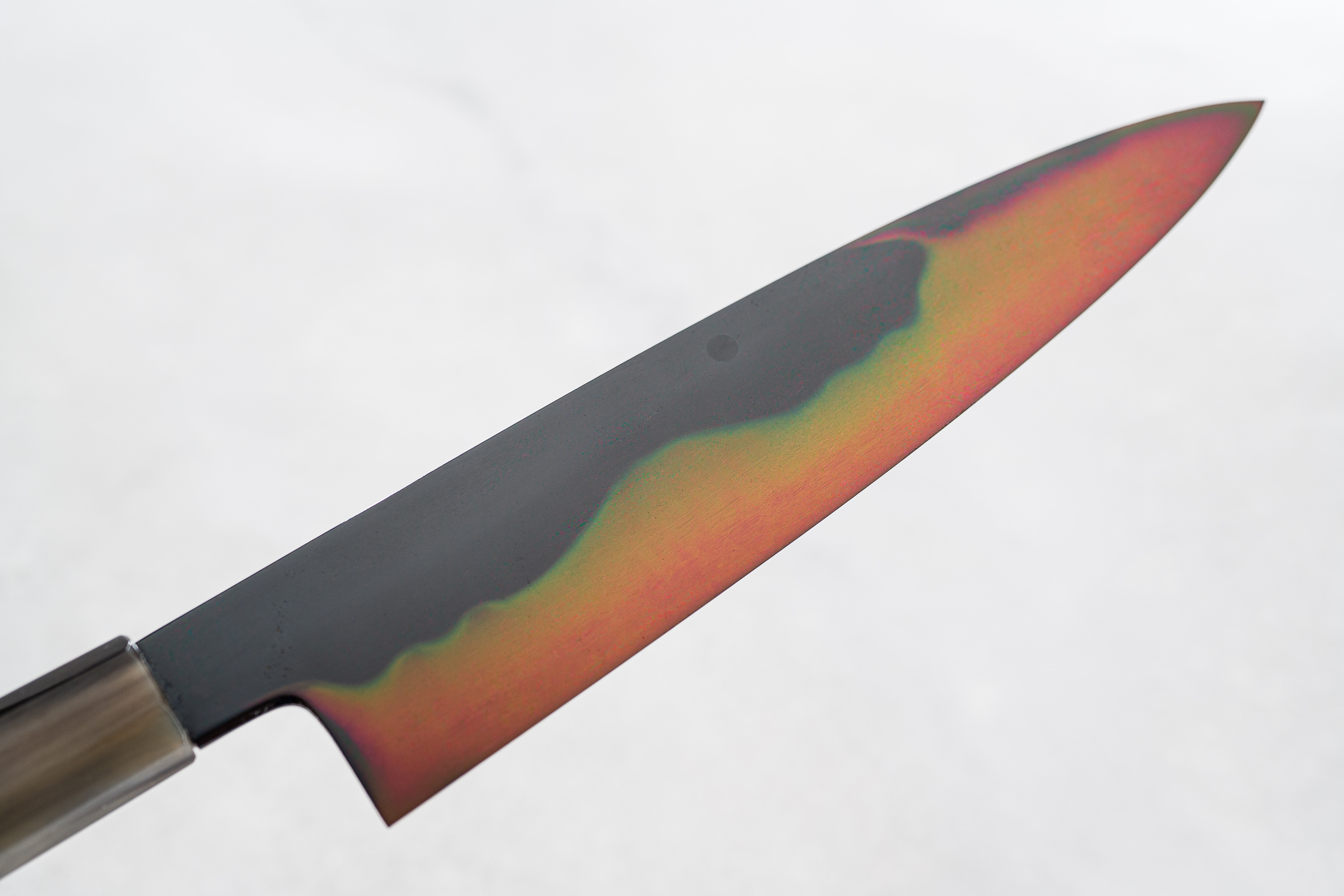
Inside Yoshikazu Ikeda's honyaki craft in Sakai — water- and oil-quenched White and Blue steel, the wave and Mt. Fuji hamon, still at the anvil near 80.
# Yoshikazu Ikeda: Sakai's Honyaki Master, Still Forging
Retailers print his name two ways, and both are correct. The kanji 池田美和 normally reads "Miwa." The trade name that appears on tags and dossiers is "Yoshikazu" — a nanori reading, the kind Japanese given names carry when the character allows more than one pronunciation. Same man, same forge, two names for the same steel. For a chef sourcing a honyaki blade, that footnote is worth knowing before it causes confusion at the point of sale.
From his father's forge to his own
Ikeda started at the anvil in 1967, under his father Kameo Ikeda, second generation of Yoshikazu Tanrenjo. When the time came to pass the forge on, his elder brother Tatsuo took over the family workshop. Yoshikazu did not inherit — he built. In 1983 he founded his own operation, Ikeda Tanrenjo, and has run it since. It is a quieter succession story than the ones with a single named heir, and a more honest one: two brothers, two forges, one lineage split cleanly down the middle.
Sakai's trade association eventually put him at its head. Ikeda now chairs the Sakai Dentō Kōgeishi Association — the body that recognizes the city's traditional-craft smiths — and retailers who carry his work describe him plainly as the top blacksmith working in Sakai today. That is not a title handed out for name recognition. It is a peer judgment, from smiths who forge in the same district and know exactly how hard the work he does actually is.
Honyaki, the hard way
Most Japanese kitchen knives are kasumi — a hard cutting-edge steel forge-welded to a softer iron or steel spine, differentially hardened so the edge holds while the body stays forgiving. Honyaki skips the lamination. The whole blade is one piece of carbon steel, hardened through a clay-coated differential quench that leaves a visible hamon where the temper line falls. There is no soft steel backing up a mistake. A honyaki blade that warps or cracks in the quench is scrap, and the failure rate in that process is the real reason honyaki costs what it costs — not romance, arithmetic.
Ikeda works across an unusually wide range for a honyaki specialist: White #1, #2, and #3, plus Blue #2, in both mizu-yaki (water quench) and abura-yaki (oil quench). Water quenching hardens faster and harder, with a higher risk of cracking; oil is gentler and more forgiving, at some cost to maximum hardness. Running both, across four steels, means Ikeda is not repeating one formula he has proven safe — he is managing four different sets of quench behavior, on purpose, blade after blade.
The wave and Mt. Fuji hamon
Honyaki hamon are not decoration applied after the fact. They are the direct, visible record of how the clay coating shaped the quench — thin clay over the edge cools fast and hard, thick clay over the spine cools slow and soft, and the boundary between the two shows up in the steel as a pattern. Retailer literature credits the Ikeda brothers with pioneering two of Sakai's more distinctive hamon styles: a wave pattern and a Mt. Fuji silhouette, often finished against a mirror-polished kyomen surface that makes the temper line read almost like ink on water. It is a claim best treated as trade attribution rather than a documented first — but it is a consistent one, repeated by multiple houses that carry his work, and it tracks with a smith who has spent decades pushing honyaki past a single safe recipe.
Still at the anvil near 80
There is no retirement announcement to report, and no successor named to inherit Ikeda Tanrenjo. As of current listings, Ikeda is close to 80 years old and still actively producing — houses including Knives & Stones, Burrfection, Zahocho, Chefs Edge, Carbon Knife Co., and Yanagi Knife carry his work, much of it under the Sakai Hokushin house line. A career now entering its seventh decade, still turning out honyaki blades one at a time, is not a common thing to find in any craft.
A candid note
Honyaki is not the knife for a chef who wants to forget it exists between shifts. A monosteel blade with no soft-steel backbone chips more readily on bone contact and demands real stone discipline to keep that edge intact — this is a blade for someone who already sharpens well and wants the steel to reward that skill, not a first Japanese knife.
A honyaki piece from a maker like Ikeda is the kind of object worth putting through its paces before any decision gets made permanent. Hagane Reserves holds pieces exactly for that — reserved for a Reserve period, in one Patron's hands at a time, with the maker's story attached to the steel.
Hagane Reserves is a premium **Japanese knife rental** in Indonesia — honyaki and other Sakai forge work held for one Patron at a time. See what is currently in the Reserves.