Hatsukokoro
Amagasaki, Hyōgo (curator house — forge undisclosed)
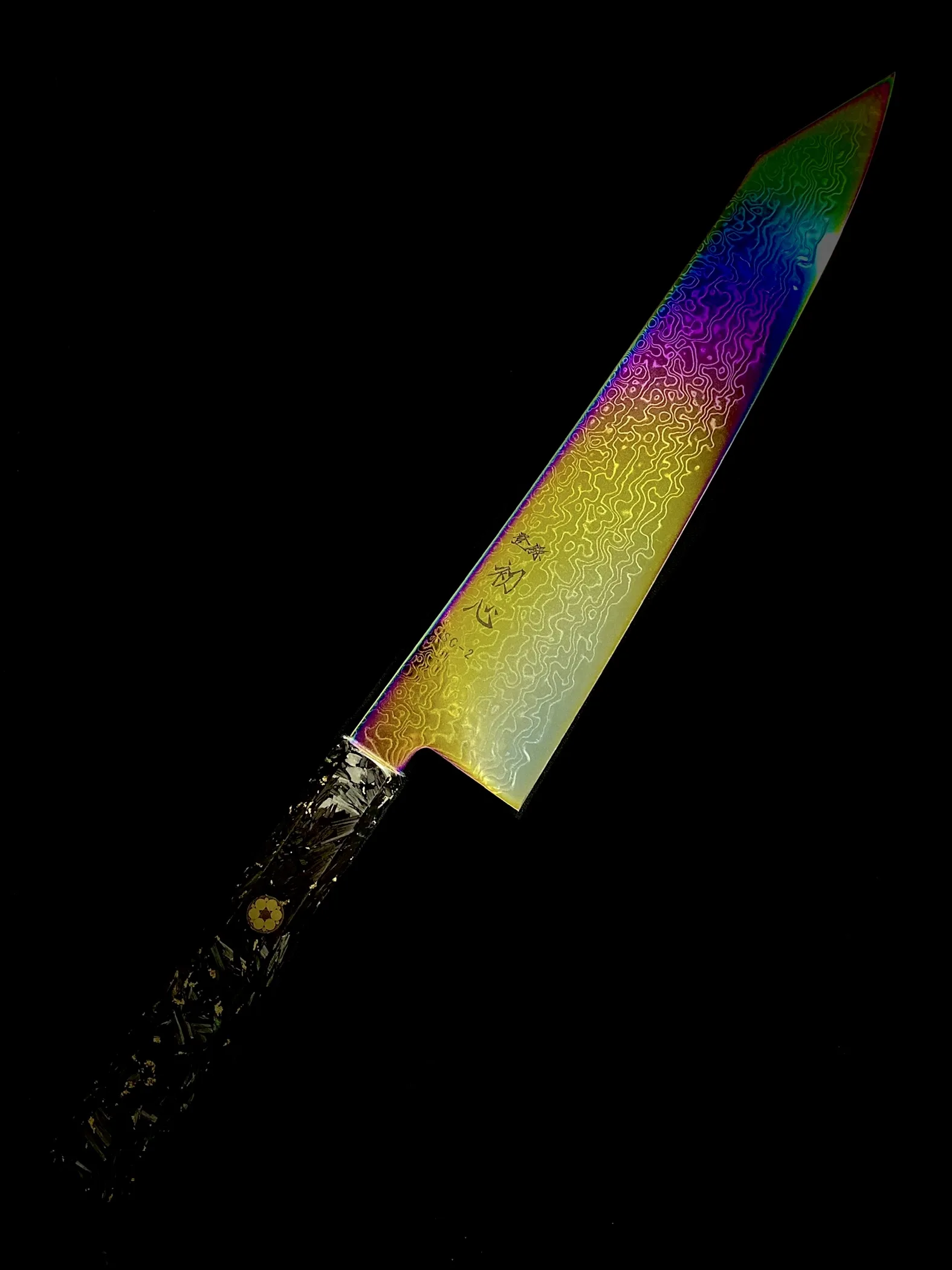
Hatsukokoro, Ryuhyo Rainbow, SG2, Kiritsuke Gyuto, 240mm, Carbon Fiber Handle
Hatsukokoro's Ryuhyo Rainbow carries a name that means drift ice — and a damascus face that moves like it. Beneath the electroplated rainbow finish sits an SG2 powdered-steel core ground thin, drawn into the kiritsuke-gyuto profile once reserved for the head chef's station. A piece of the Reserves, held for one Patron at a time.
The makers, and the making
House — Hatsukokoro, Amagasaki, Hyōgo. A curator house, not a single forge: each line is commissioned from Japanese workshops chosen for the task — Sakai, Tosa, Sanjo, Seki among them. The workshop behind Ryuhyo is kept undisclosed by the house.
Steel — SG2 powdered stainless steel from Takefu Special Steel, Echizen. Atomised to powder and sintered so the carbides stay uniform and fine; hardened to 62–64 HRC.
Construction — San-mai: the SG2 core sheathed in multi-layered stainless damascus, mirror-polished so the pattern reads like flowing ice.
Finish — Electroplated rainbow coating over the damascus. Metallic, not paint — it shifts with the light. Hand-wash only; the edge reveals bare steel as it is sharpened, as intended.
Grind — Thin behind the edge, with a smooth sabre-style transition and no defined shinogi line — food glides off an unbroken face.
Edge — Double bevel, 50/50, sharpened for both left and right hands.
Profile — Kiritsuke gyuto, 240 mm. Flat-biased edge with the angled K-tip.
The maker forged it. You command the table.
- Reserve period
- Minimum 2 days
- Rental rate
- Rp 150.000
- per day
- Security deposit
- Rp 5.040.000
- Fully refundable when the piece returns in the agreed condition
- How the deposit comes back
From the forge
Hatsukokoro takes its name from an old admonition of the Japanese arts: shoshin wasuru bekarazu — never forget the beginner's heart. It is a young house from Amagasaki, Hyōgo, built the old way in reverse: rather than one forge making everything, Hatsukokoro goes out to the workshops of Sakai, Tosa, Sanjo and Seki and commissions each line from the hands best suited to it. The house lends its name only to blades that honour the intention it was named for.
Ryuhyo means drift ice. Each winter, ice born in the Amur River crosses the Sea of Okhotsk and arrives on the coast of Hokkaidō — the southernmost drift ice in the northern hemisphere, a white field that moves as one body. Look down the blade and the name explains itself: layer upon layer of stainless damascus, mirror-polished, flowing along the face the way pack ice flows past the shore.
The line itself was born from self-criticism. Hatsukokoro's earlier Saihyo series was admired for its face but questioned for its grind — handsome, but not thin where it counts. Ryuhyo is the house's answer: pulled thinner behind the edge, the bevel transition smoothed into one unbroken surface without a shinogi line, so the damascus flows uninterrupted and food releases instead of clinging. On this piece the answer wears colour — an electroplated rainbow finish that shifts across the pattern as the light moves, like low sun crossing the ice.
The profile carries its own history. In the traditional kaiseki kitchen, the single-bevel kiritsuke belonged to one station only: the itamae, the chef who stood before the board. A junior cook did not reach for it — the knife was a quiet declaration of rank, mastery of fish and vegetable work in a single blade. The modern kiritsuke gyuto is that declaration translated for the double-bevel age: the gyuto's all-purpose heart under a flatter edge and the angled K-tip. That tip is the point of it, literally — an acute, needle-fine reach that drops the thinnest slices and the most exact incisions exactly where the eye puts them, while the flat run of edge takes long pull cuts through to the board.
At its core runs SG2 — powdered steel from Takefu, atomised and sintered so its carbides stay almost impossibly fine, hardened to 62–64 HRC. It holds its edge through long service and still answers an ordinary whetstone. The coating asks one courtesy in return: hand-wash, no abrasives, and let the edge show bare steel as sharpening reveals it — drift ice melts at the waterline, and the blade is more beautiful for being used. The piece is held for one Patron at a time, and when the Reserve period ends it returns to the Reserves, inspected and readied for the next table it will command.
Held for one Patron at a time, for the length of a Reserve period.