Satoshi Nakagawa
Sakai, Osaka (forged) · Tosa, Kochi (ground)
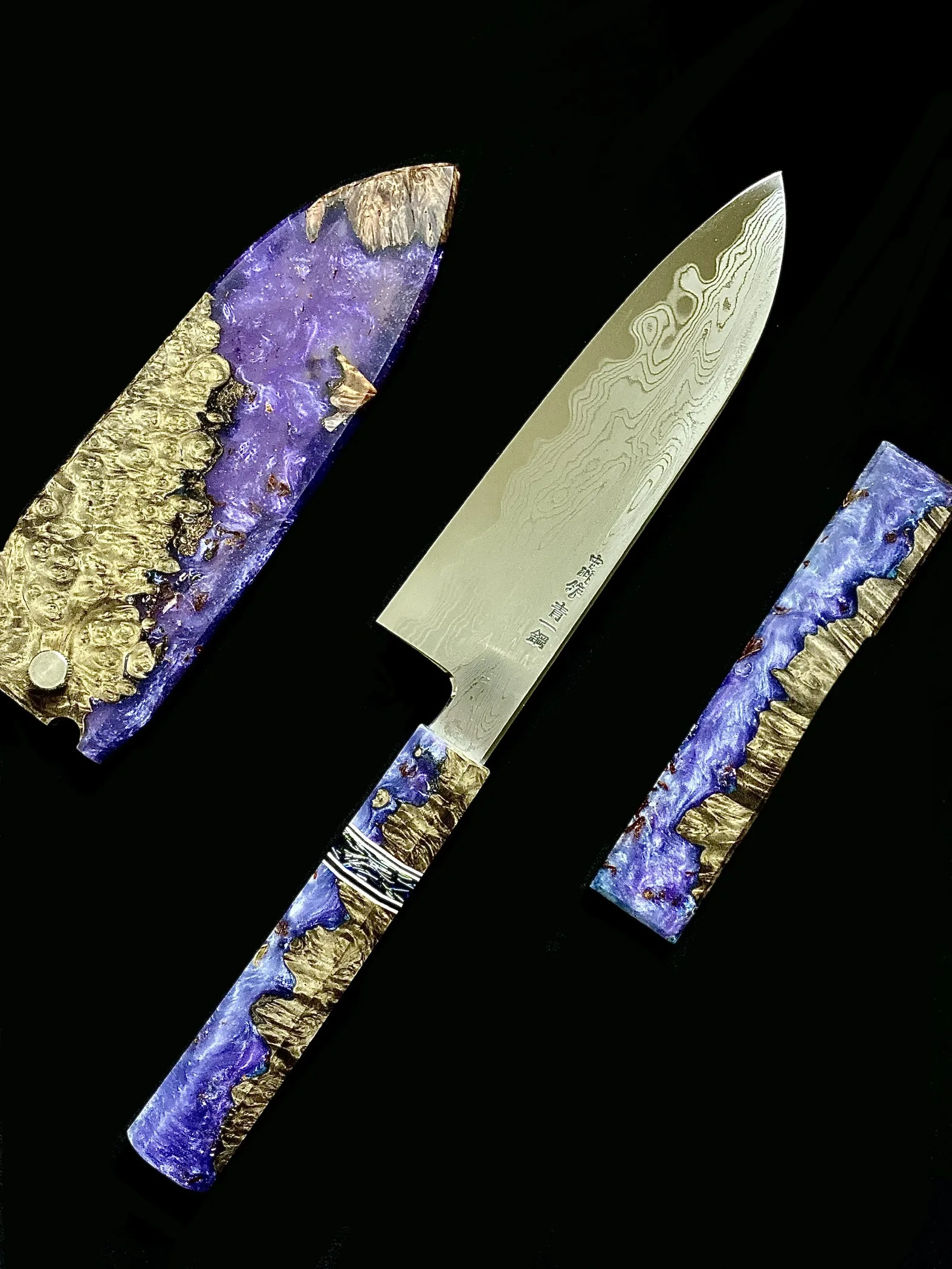
Nakagawa x Naohito Myojin, Blue 1 Damascus, Santoku, 180mm, Hoja Custom Amboyna Burl Handle + Saya
Satoshi Nakagawa forged it in Sakai; Naohito Myojin ground it in Tosa. An Aogami #1 core under polished damascus, in the santoku form — Japan's everyday blade, here made by two of its most honoured hands, and dressed in Indonesian amboyna burl. A piece of the Reserves, held for one Patron at a time.
The makers, and the making
Smith — Satoshi Nakagawa (中川悟志), Sakai, Osaka. Sixteen years as the only apprentice of honyaki master Kenichi Shiraki before opening his own forge in 2021; in 2023 he was recognised as a Dentō Kōgeishi (certified Traditional Craftsman) — the youngest ever in Sakai knife forging.
Sharpener — Naohito Myojin (明神直人), Myojin Riki Seisakusho, Susaki, Tosa (Kochi). Second generation of a grinding house founded in 1950; the sharpener credited with the Konosuke Fujiyama line, known for grinds of unusual thinness and precision.
Steel — Aogami #1 (Blue #1) carbon steel from the Yasugi works, Shimane — white steel refined with tungsten and chromium for a longer-holding edge; 62–63 HRC.
Construction — San-mai: the carbon core clad in soft-iron damascus, polished so the pattern moves with the light.
Character — Reactive carbon steel: it will build a patina that records its use, and asks to be wiped dry after service. A living blade.
Edge — Double bevel.
Profile — Santoku, 180 mm edge; 47.7 mm at the heel; 150 g.
Handle & saya — Matched set in amboyna burl — the prized burl of Pterocarpus indicus, named for the island of Ambon in Maluku — carved and fitted by the Indonesian craftsman Byan Hoja.
The maker forged it. You command the table.
- Reserve period
- Minimum 2 days
- Rental rate
- Rp 200.000
- per day
- Security deposit
- Rp 9.000.000
- Fully refundable when the piece returns in the agreed condition
- How the deposit comes back
From the forge
In Sakai, no one makes a knife alone. For six centuries the city has split the craft between specialists — one workshop forges, another grinds, another fits the handle — each lifetime spent mastering a single step. This piece carries that tradition with both names written out. The forging belongs to Satoshi Nakagawa, who spent sixteen years as the only apprentice of the honyaki master Kenichi Shiraki, kept the workshop running through his teacher's illness, and opened his own forge in 2021. Two years later Japan recognised him as a Dentō Kōgeishi, a certified Traditional Craftsman — the youngest in the history of Sakai knife forging.
The grinding travelled south. In Susaki, on the Tosa coast of Kochi, Myojin Riki Seisakusho has been shaping blades since 1950; Naohito Myojin is its second generation, and among people who study Japanese knives his name on a blade means the geometry will be almost impossibly thin, true, and even. He is the sharpener credited with the Konosuke Fujiyama line — work that made his grind a reference point. When Nakagawa's forgings meet Myojin's stones, two of the most respected hands of their generation share one blade.
The steel is Aogami #1 from the Yasugi works in Shimane — the famous "blue paper" steel, named for the colour of the wrapper each grade shipped in. It is white steel refined with tungsten and chromium, holding its edge longer while keeping the vivid, glassy sharpness carbon steel is loved for. Around it, soft-iron damascus is polished until the layers ripple; beneath, the core will slowly darken into a patina that records every service. It asks only to be wiped dry — the same small courtesy Japanese kitchens have paid their blades for centuries.
The form is deliberately humble. The santoku — "three virtues" — was born in post-war Japanese homes as one knife for meat, fish and vegetables, and it remains the everyday blade of Japan, the shape found in nearly every household kitchen. That is what makes this one quietly audacious: the country's most ordinary silhouette, executed by a record-setting Sakai smith and the grinder the collectors chase. Tall at the heel and flat through the edge, it does everything a table demands and does it with a lightness the spec sheet cannot convey.
Then the piece comes home. Its handle and fitted saya are a matched set of amboyna burl — the swirling burl of Pterocarpus indicus that takes its name from the island of Ambon in Maluku, a wood so prized it once panelled Rolls-Royce dashboards — carved and fitted by the Indonesian craftsman Byan Hoja. A Sakai blade, a Tosa edge, and an Indonesian dress by Byan Hoja's hand: three crafts, three places, one piece. It is held for one Patron at a time, and when the Reserve period ends it returns to the Reserves, inspected, oiled and readied for the next table it will command.
Held for one Patron at a time, for the length of a Reserve period.